
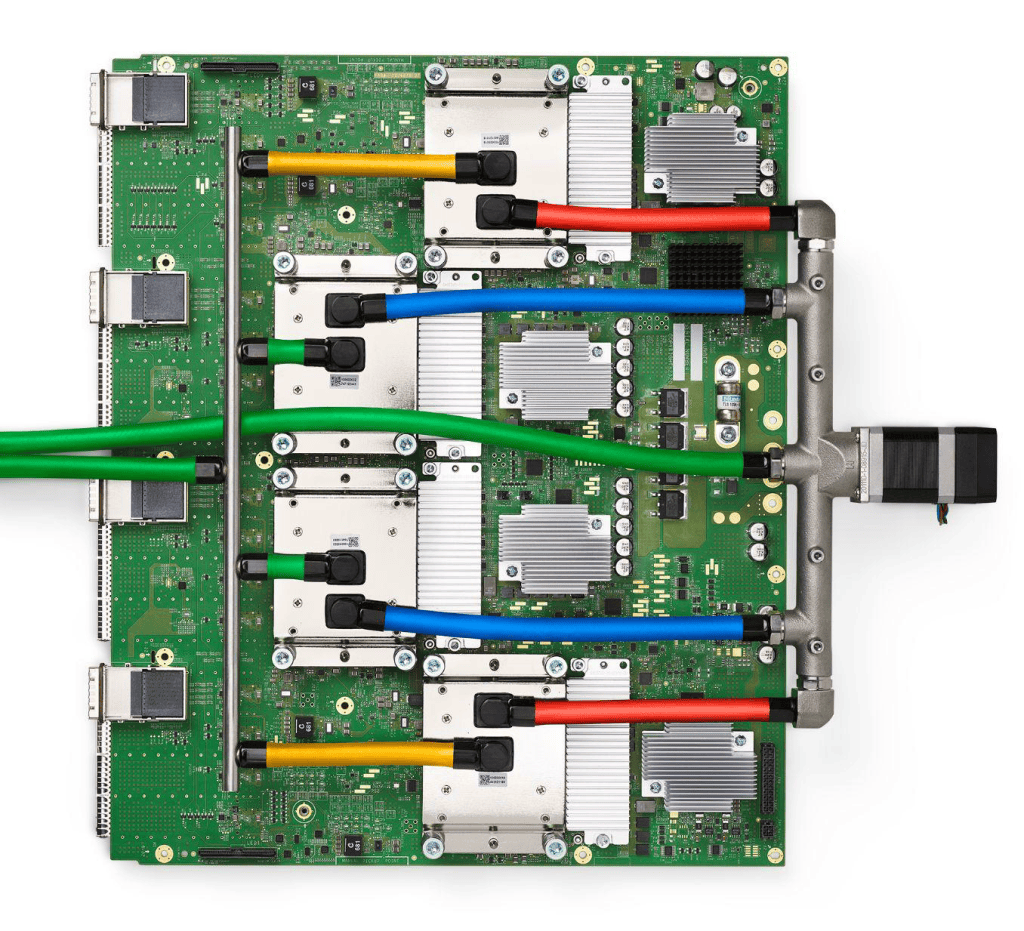
Top image: A Google TPU v4 board with four liquid-cooled chip packages, from a 2023 research paper. Photo: Norman P. Jouppi et al. / CC BY 4.0 via Wikimedia Commons
The most important thing Nvidia sells may not be a chip. It is the habit of millions of developers who write AI software assuming Nvidia hardware will run it. This week, two of the world’s largest cloud companies used a conference at the San Jose Convention Center to try to break that habit.
On Tuesday, Google announced at PyTorch Conference 2026 that TorchTPU, its native PyTorch software stack for Google’s Tensor Processing Units, is now available as open source on GitHub. A day earlier, Amazon said its own counterpart, TorchNeuron, would be released under the Apache 2.0 license at the same conference, letting PyTorch code run on Amazon’s Trainium chips. The Linux Foundation lists PyTorch Conference North America as running Oct. 20-21 at the San Jose convention center, according to the event site.
Why PyTorch is the battlefield
PyTorch is the open-source toolkit developers use to build, train and run AI models. Amazon says 85% of AI researchers and developers write their code in it, and TechCrunch cited a similar figure for AI apps. Meta created the framework in 2016, when Nvidia GPUs were already the standard for AI research, so many of its features were built around Nvidia chips, TechCrunch reported. Meta handed PyTorch to the Linux Foundation in 2022.
That history created a kind of lock-in. Moving to another chip has typically meant rewriting and revalidating code. Amazon’s announcement frames the problem bluntly: expanding to new hardware “meant rewriting and revalidating work that took months to perfect.”
What each company is promising
Google says TorchTPU lets developers run existing PyTorch workloads on TPUs “with minimal code changes,” debugging in eager mode and then using torch.compile for production performance. It says the stack was co-developed with Meta’s PyTorch team and integrates with widely used tools including vLLM, SGLang, Ray and Hugging Face, where deploying a model to a TPU in Transformers v5 can be as simple as passing a device setting. Google also announced a TPU agent suite in preview to help automate onboarding and tuning.
Meta’s endorsement is notable. “We cannot be constrained by a single hardware architecture,” Jana van Greunen, Meta’s director of PyTorch engineering, said in Google’s announcement, adding that TorchTPU supports major LLM, ads and recommendation workloads on key production use cases.
Amazon says TorchNeuron runs existing PyTorch code on Trainium2 and Trainium3 with “a single configuration change and no rewrite.” It also says it is contributing changes upstream to PyTorch to remove code that ties the framework to specific chips. Amazon described the hardware behind it as the product of a decade of custom silicon work since it acquired Annapurna Labs in 2015.
The caveat
Neither announcement means developers will abandon Nvidia. “None of this means AI app developers will automatically ditch Nvidia’s hardware en masse,” TechCrunch’s Julie Bort wrote. Portability claims are also the companies’ own; performance and cost will vary by workload, and independent benchmarks will matter more than launch-day demonstrations. Google’s reported results, such as up to 52% model FLOPs utilization on one open model across thousands of its newest TPUs, are vendor figures.
The long view
For Silicon Valley, the subtext is local. Nvidia is headquartered in Santa Clara, and its advantage has rested as much on software familiarity as on transistors. The South Bay Chronicle has tracked how demand for its chips keeps outrunning the power available to run them, a pressure that now shapes the region’s data center politics. If code becomes genuinely portable, the competition shifts to price, power efficiency and availability, the variables that hyperscalers with their own chips and data centers control. That would not end Nvidia’s dominance quickly, but it would change what the dominance is built on. Watch whether major model developers publicly move production workloads, not just pilots, over the next year.
Sources
- TorchTPU is now open source: Run native PyTorch on TPUs, Google Cloud Blog, Oct. 20, 2026
- Amazon opens its AWS Trainium AI chips to every PyTorch developer, About Amazon
- Google has joined Amazon in attacking Nvidia’s stronghold with AI app developers, TechCrunch, Oct. 20, 2026
- PyTorch Conference North America: Venue & Travel, The Linux Foundation


Leave a Reply