
PREMIUM
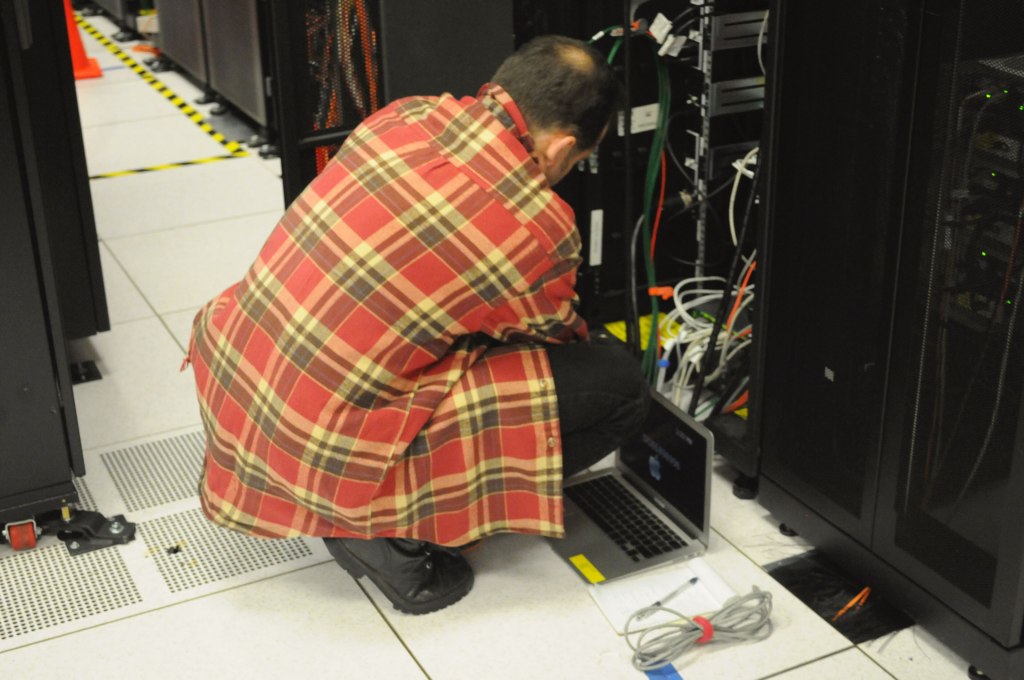
Top image: A technician works on server racks at a Bay Area research data center in 2011. Photo: Derrick Coetzee from Berkeley, CA, USA / CC0 via Wikimedia Commons
Within 48 hours this week, two governments at opposite ends of the region moved on the same problem in different ways. On Monday, Gilroy’s City Council unanimously extended its pause on new data centers until September 2027. On Tuesday, the San Mateo County Board of Supervisors told staff to study zoning rules for data centers in unincorporated areas, after a supervisor objected to language that presumed a countywide ban.
Add San Francisco’s citywide moratorium, Santa Clara’s power-constrained limbo and San Jose’s push for permanent standards without a pause, and Silicon Valley now has at least five distinct approaches to the facilities that power artificial intelligence. The South Bay Chronicle reviewed the resolutions, staff reports, planning summaries and municipal records behind each. Together they show a region improvising, and the common gaps that improvisation leaves.
San Mateo County: a study, not a ban
The resolution supervisors took up, File No. 26-853, was sponsored by Supervisors Lisa Gauthier and Noelia Corzo. As drafted, it directed the Planning and Building Department, the County Executive’s Office and the County Attorney’s Office to “consider and prepare appropriate amendments to the County’s Zoning Regulations, including a potential Countywide ban, on new data center construction” in unincorporated San Mateo County.
The supervisors’ memo makes three arguments. First, it says the AI boom has produced “a corresponding surge” in large-scale data center construction. Second, it cites state legislation requiring data centers to disclose and report water use (AB 2619 and AB 2469) and ensuring that new data centers are subject to environmental review (SB 887). Third, it asserts that the county’s existing zoning “do[es] not currently include adequate provisions” to regulate the siting, construction and operation of what it repeatedly calls “AI-scale data centers.” The memo reports no net county cost for giving the direction.
Notably, the memo asked staff to consider “whether AI-scale data centers are an appropriate land use in any zones within the unincorporated County, or whether a Countywide ban on the construction of new data centers should be enacted.”
That framing did not survive intact. Supervisor Jackie Speier objected that the resolution “presupposes” a ban, according to Bay City News, as published by SFGate. “I would rather us consider all the elements as opposed to going immediately to a countywide ban,” she said. The board approved the study by majority vote without the countywide-ban consideration as originally written, the report said. Corzo, the co-sponsor, and Supervisor David Canepa were absent for the vote. As of Wednesday morning, the county’s legislative record had not yet posted the final action or amended text.
Gauthier said the county lacks the land and water to support data centers, but that its proximity to the AI industry warrants preparation. “Our region, Silicon Valley, is a hotbed of potential data center development with numerous projects in some phases of planning or development,” she said, according to Bay City News. She also said the San Mateo County Event Center had been solicited as a potential site, a pitch the South Bay Chronicle reported last week was rejected by county leaders.
Gilroy: the moratorium clock
Gilroy is the only jurisdiction in the region with a large hyperscale project already under construction, and its rules reflect that. The city’s own moratorium Q&A explains the legal clock. Under California Government Code Section 65858, an initial moratorium lasts 45 days, can be extended once for up to 10 months and 15 days, and then once more for up to 12 months, for a maximum of two years.
On Monday, the council used the first extension. The moratorium now expires Sept. 3, 2027, and can be extended once more, San José Spotlight reported. It does not affect Amazon’s data center under construction on a 56-acre site at 8050 Camino Arroyo, but it halts a second Amazon Web Services project at Highway 152 and Camino Arroyo, which is in pre-application and has no formal application on file, according to Spotlight and the city.
The city’s Q&A identifies the underlying problem: Gilroy’s zoning code “does not specifically define data centers as a distinct land use,” folding them into a broader category of “data processing establishments.” Staff plan to study water use and cooling, electrical demand and grid capacity, backup generators and emissions, noise, aesthetics and traffic. “The goal is to further enhance protections to public health, infrastructure and neighborhood quality of life,” City Administrator Matt Morley told Spotlight.
Amazon representatives have said the company is investing in local land conservation and water replenishment projects, using 100% carbon-free energy, committing to 100% recycled water by 2030 and covering infrastructure costs, according to Spotlight.
San Francisco: borrowing the state’s definition
San Francisco’s 45-day interim moratorium took effect Oct. 16 and runs until Nov. 30 unless extended, according to the city Planning Department’s code summary. Before the moratorium, the city classified data centers as an “Internet Service Exchange” requiring conditional use authorization.
The most transferable detail is the definition. Rather than write its own, San Francisco adopted SB 887’s: a facility housing “computing infrastructure, including graphics and central processing units, servers, storage devices, networking equipment, and associated power and cooling systems, for the primary purpose of processing, storing, or distributing electronic data.” The moratorium exempts data centers that are accessory to other uses and repair work that does not add size or capacity.
Santa Clara: limits imposed by the grid
Santa Clara, which KQED reports has nearly 60 data centers generating about $35 million for the city last year, almost 10% of its general fund, faces a different constraint. Its city-owned utility, Silicon Valley Power, stopped accepting power applications from data center developers in 2023 and is in the middle of a $450 million upgrade expected to run to 2030. Two approved data centers are under construction and eight more that received power approvals before the cutoff are waiting, KQED reported. About 54% of the city’s power goes to data centers.
City staff told the council the utility pause is not a moratorium, because developers can still pursue land-use entitlements. City Attorney Glenn Googins said most new data centers would require discretionary conditional use permits and council approval, San Jose Source reported.
Councilmember Karen Hardy’s request for a moratorium option on new standalone data centers was on Tuesday night’s agenda as Item 7 (File No. 26-1106), deferred from Oct. 6. Such requests are for deciding whether to place a matter on a future agenda for a report or action, not for debating its substance, according to the staff report for the original request. As of Wednesday morning, the city’s records did not show an outcome. The South Bay Chronicle will update when results are posted.
San Jose: standards, no pause
San Jose is writing permanent standards for “large load” data centers and research facilities drawing 20 megawatts or more. The current draft, which the city stresses is subject to change, would require recycled-water or low-water cooling and EPA Tier 4 backup generators, as the South Bay Chronicle detailed last week. Residents at an Oct. 15 community meeting called for a moratorium, and the City Council is expected to finalize the standards in December, San José Spotlight reported. A moratorium appears off the table in San Jose despite residents’ concerns, Spotlight reported separately.
What the documents have in common
Read side by side, the records point to the same three gaps.
First, definitions. Gilroy’s code has no distinct data center use. San Francisco previously treated data centers as Internet Service Exchanges and had to import SB 887’s definition. San Mateo County’s memo says its zoning lacks “adequate provisions.” Local governments are discovering that the land use underpinning the AI economy is not clearly named in their codes.
Second, the decisive constraint is often not zoning but power. Santa Clara’s de facto limit comes from its utility, not its council. San Jose’s standards hinge on a megawatt threshold. San Mateo County’s own sponsors acknowledge limited land and water. Zoning can say where a data center may go; only utilities can say whether it can run.
Third, timing. Gilroy’s state-law clock gives it until September 2027, with one more extension available. San Francisco’s runs through Nov. 30 unless extended. San Mateo County has set no public deadline for staff. San Jose plans December action. A developer surveying the region today faces a map of pauses, studies and draft rules with different expiration dates.
The long view
The policy question is shifting from whether to allow data centers to what kind and on whose terms. The early answers are local and inconsistent, and that has consequences. Projects tend to move toward the least friction, which could mean jurisdictions with available power and the oldest codes, not the best sites. A shared regional or state framework, built on definitions like SB 887’s and tied to real grid capacity, would give residents and developers more predictability than five rulebooks with five clocks. Until then, the most important data center decisions in Silicon Valley may be made in planning departments and utility offices, through staff reports few residents read. The South Bay Chronicle will keep reading them.
Sources
- File No. 26-853, Resolution Directing Staff to Develop Zoning Regulations for Data Centers, San Mateo County Board of Supervisors (memo and draft resolution)
- San Mateo Co.: Supes Weigh Possible Zoning Restrictions On Data Center Construction, Bay City News via SFGate, Oct. 20, 2026
- Data Center Moratorium Q&A, City of Gilroy
- Gilroy extends moratorium on data center projects, San José Spotlight, Oct. 20, 2026
- New Planning Code Summary: Interim Zoning Moratorium for Data Centers, San Francisco Planning Department
- Santa Clara, California’s Capital of Data Centers, Weighs More Regulations, KQED, Oct. 8, 2026
- Santa Clara Approves New Data Center Standards, Moratorium Discussion Ongoing, San Jose Source, Oct. 11, 2026
- File No. 26-1106 and File No. 26-1016, Santa Clara City Council
- San Jose’s proposed data center rules draw criticism over environmental protections, San José Spotlight via Local News Matters, Oct. 20, 2026
- San Jose Says Its Data Center Rules Will Be Among the Strictest in the Nation, South Bay Chronicle, Oct. 18, 2026


Leave a Reply