
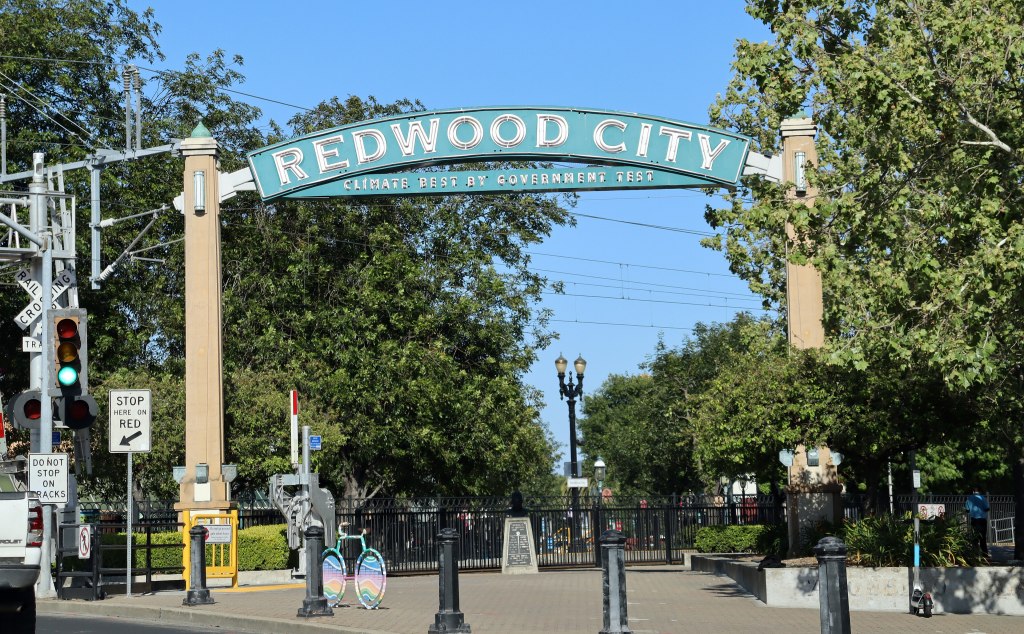
Top image: The arch at the western end of downtown Redwood City, home to the Chan Zuckerberg Initiative. Photo: Coolcaesar / CC BY 4.0 via Wikimedia Commons
The gala circuit tends to measure Peninsula philanthropy in naming rights and auction paddles. The Chan Zuckerberg Community Fund works in a quieter register: two-year checks, capped at $200,000, written to food pantries, tutoring programs and housing nonprofits from East Palo Alto to the coast. This year it turned ten.
The fund’s 2026 cohort, announced by the Chan Zuckerberg Initiative on Sept. 17 and circulating again this week, names 34 San Mateo County organizations. It arrives at a moment when the family behind it is unusually visible. On Wednesday, Meta disclosed that Mark Zuckerberg has committed to remain a California resident for eight years, a pledge the Chronicle examined in detail after reading the company’s filings. The Community Fund is a reminder of the local commitments that sit alongside that headline.
Who made the list
The grantees run the length of the county’s social map. Housing is represented by HIP Housing and the Housing Endowment and Regional Trust of San Mateo County (HEART). East Palo Alto organizations include EPACANDO, EPACENTER, the East Palo Alto Community Archive and Belle Haven Action across the line in Menlo Park. Education grants go to Homework Central, Peninsula Bridge, Foundation for a College Education, StreetCode Academy, Upward Scholars and Project READ-Redwood City. On the coast, Senior Coastsiders, Big Wave Group and Abundant Grace Coastside Worker made the cut. Health and aging grants include the Lucile Packard Children’s Hospital Stanford Teen Van, Healthcare in Action, Bay Area Cancer Connections, AgeUp and Hope Services. Youth organizations include both Boys & Girls Clubs of the Peninsula and Boys & Girls Clubs North San Mateo County, CASA of San Mateo County and Friends for Youth. St. Anthony’s Padua Dining Room, Music at Kohl Mansion, Renaissance Entrepreneurship Center and Pacific Community Ventures round out a list that is less a portfolio than a cross-section.
“We are honored to partner with this year’s grantees, who are meeting urgent needs and creating long-term opportunities across San Mateo County,” Alma Pulido, who leads the fund, said in the announcement.
Benjamin N. York, executive director of Homework Central, said the grant helps the organization keep its model “completely free for families,” from tutoring at six after-school sites to STEAM projects with partners such as CuriOdyssey. “It’s an investment not just in test scores, but in the dignity and confidence our students carry with them,” he said.
How the money is decided
The mechanics are spelled out in CZI’s request for applications. Applicants must serve San Mateo County and work in one of seven priority areas: affordable housing, homelessness, food security, workforce development, health and wellbeing, education and youth, and arts and culture. Proposals are reviewed by a panel of CZI employees. The 2026 round, opened May 5, was the fund’s tenth grantmaking cycle. Since 2017, CZI says, the fund has invested more than $38 million in more than 200 local nonprofits.
By the standards of a philanthropy that has committed billions to biomedical science, $38 million over a decade is modest. By the standards of a county nonprofit with a seven-figure budget, a two-year grant of up to $200,000 can fund a program coordinator, a second site or a year of breathing room.
The society read
On the Peninsula, influence is often exercised through the board seat and the benefit dinner. The Community Fund is the opposite model: unbranded operating support decided by staff, with a narrow geographic brief centered on the county where CZI is based in Redwood City and where Meta’s headquarters sits in Menlo Park. It is the kind of giving that rarely makes the society pages, which is precisely why it is worth noting.
The long view
The next decade of San Mateo County philanthropy will be shaped by two pressures at once: rising need among the county’s working families and growing uncertainty about the tax and residency decisions of its wealthiest residents. The billionaire tax on the Nov. 3 ballot has made the second question public. Whatever voters decide, the organizations on this list are a measure of how much of the local safety net now runs through private, renewable grants, and how much depends on donors choosing to stay engaged close to home.


Leave a Reply