
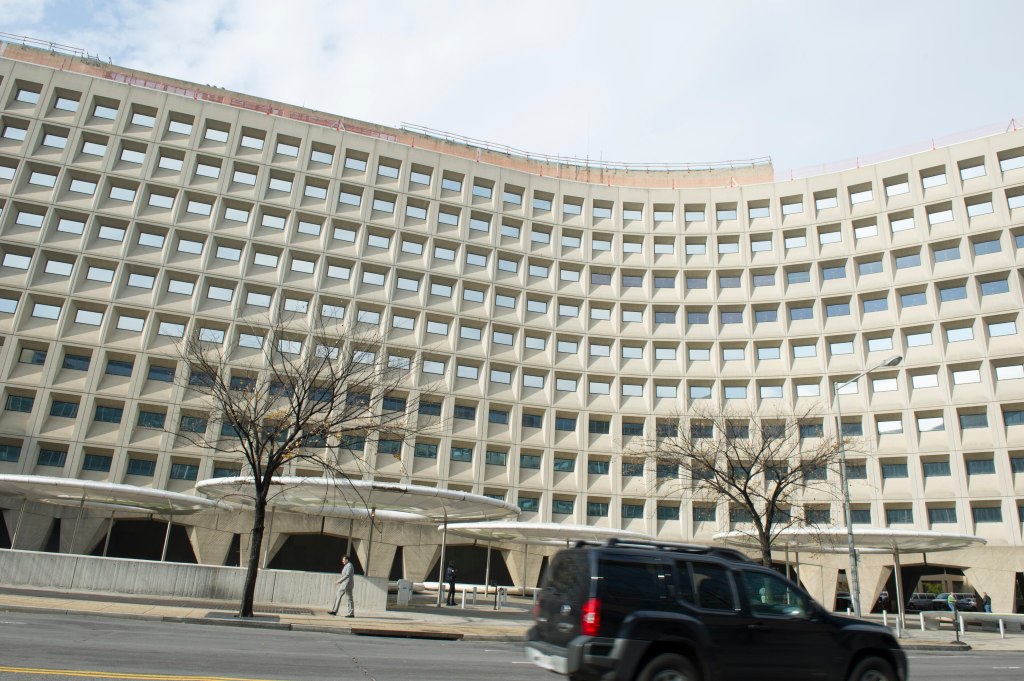
Top image: The U.S. Department of Housing and Urban Development headquarters in Washington, D.C. Photo: HUD staff photographer (public domain) via Wikimedia Commons
Santa Clara County has spent years making the case that the cheapest way to fight homelessness is to stop it before it starts. This week brought two tests of that idea at once: a sudden federal funding loss that could push 40 medically vulnerable South Bay residents out of their homes, and a new state law that adopts the county’s prevention approach without paying for it.
The cut
Bay Area Community Health, which runs clinics from Hayward to Gilroy, recently learned that its annual funding through the federal Housing Opportunities for Persons with AIDS program, known as HOPWA, had dried up, NBC Bay Area reported. The loss is more than $400,000, and the clinic has notified 40 affected households that their housing subsidies will end Oct. 30, according to the report.
“We just became aware of this a week ago,” Dr. Zettie Page, BACH’s president and CEO, told NBC Bay Area. “So the what now is still on the table.”
San Jose Mayor Matt Mahan blamed federal decisions. “Forty vulnerable people potentially right out on the streets,” he said. “Medically vulnerable. They cannot work. They have life-altering medical conditions.” He called the cuts “cruel” and said the city cannot backfill the $400,000 because of its own budget shortfalls. Instead, city leaders are engaging the South Bay congressional delegation and hoping the county will release Measure A funds, according to NBC Bay Area.
NBC Bay Area said it had asked the U.S. Department of Housing and Urban Development, which runs the HOPWA program, for comment and had not received a response. The South Bay Chronicle has not independently confirmed the reason the funding ended.
The new state blueprint
The same week, San José Spotlight reported that California is beginning its first statewide homelessness prevention strategy after Gov. Gavin Newsom signed Assembly Bill 1924 last month. The law requires the California Interagency Council on Homelessness to produce measurable prevention goals and an action plan by July 1, 2028, and to recommend high-impact local efforts for future funding.
The law does not include funding for prevention programs because of budget constraints, meaning costs could fall to cities and counties, the outlet reported.
The arithmetic behind prevention is stark. In Santa Clara County, homelessness reached an all-time high of more than 10,700 people last year, and nearly 60% of homeless residents surveyed in the 2025 point-in-time count said they were homeless for the first time, according to San José Spotlight. For every person housed in the county, nearly two become homeless.
“The county is pleased to see that California is implementing a statewide homelessness prevention strategy, and we are eager to share the success of our local program to inform the statewide strategy,” Kathryn Kaminski, director of the county Office of Supportive Housing, told the outlet. She said efforts to replicate the program are underway in 10 communities nationally through an initiative called Right at Home USA.
Where the two stories meet
BACH’s situation is the scenario prevention programs are built for: people who are housed today, have a known end date for their assistance and face serious health risks if they lose their homes. Whether the county uses Measure A dollars, as Mahan hopes, or another prevention source will show how flexible the local safety net is when federal money disappears with little notice.
The long view
California is formalizing a strategy that Santa Clara County pioneered, but it is doing so as federal housing and health dollars become less predictable and the state declines to fund the plan it is mandating. That combination pushes the cost and the risk down to counties. The 40 BACH households are a small number against a homeless population of more than 10,700, but they illustrate the larger problem: prevention works only if someone can move money quickly when a funding stream ends. Watch whether county supervisors act before Oct. 30, and whether the state’s 2028 plan comes with a budget.
Sources
- Federal grant cuts threaten South Bay housing program for 40 vulnerable patients, NBC Bay Area, Oct. 19, 2026
- State homeless prevention plan modeled on Santa Clara County, San José Spotlight, Oct. 20, 2026


Leave a Reply