
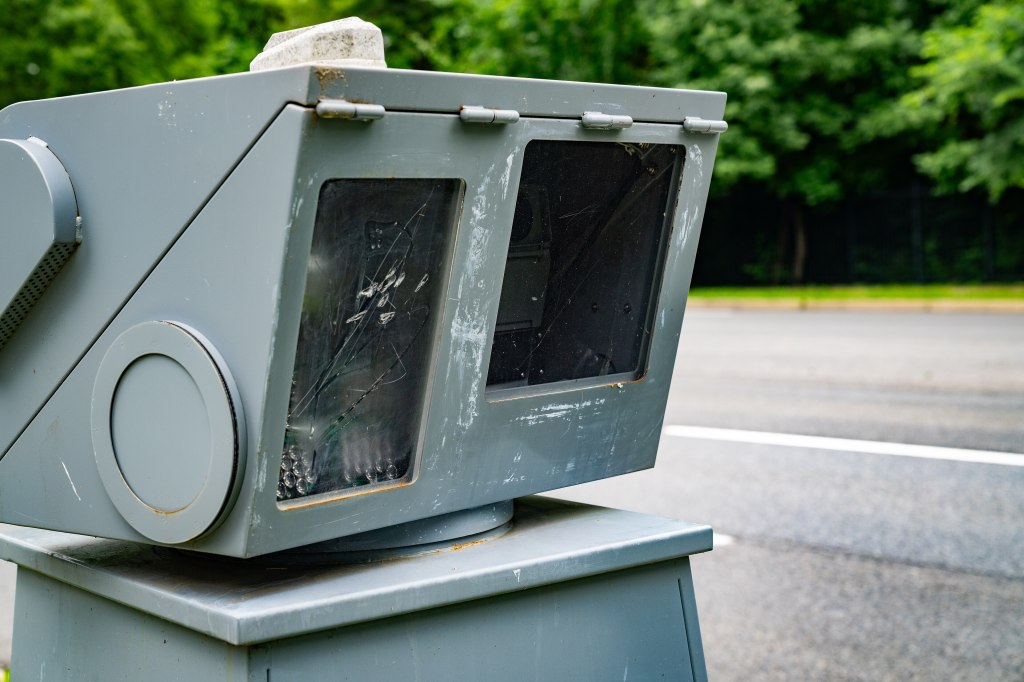
Top image: A speed enforcement camera in Bethesda, Maryland. San Jose’s systems may look different. Photo: Tony Webster / CC BY 2.0 via Wikimedia Commons
After years of planning, San Jose’s speed cameras are becoming physical. The city has begun installing 33 automated speed enforcement cameras across San Jose under a five-year pilot authorized by state law, ABC7 News reported Tuesday. Two are already up on Saratoga Avenue, near the site of a motorcycle crash that killed a woman several weeks ago, according to the station.
The backdrop is grim. San Jose has recorded 41 traffic fatalities this year, ABC7 reported. The city’s program page notes that 2022 was the deadliest year in modern history on its streets, with 65 deaths, and that speeding was a contributing factor in 33% of traffic fatalities from 2018 to 2022.
How it works
Assembly Bill 645, passed in October 2023, allows San Jose and five other California cities to test speed cameras, according to the city. San Jose may operate up to 33 systems, and the pilot must end and report results after five years or by the start of 2032, whichever comes first.
The city says cameras will be placed at least one per City Council district, at locations chosen for crash history, frequent speeding of 10 mph or more over the limit and proximity to schools, parks, hospitals and senior centers. School zones themselves were excluded because of state restrictions on when cameras can operate there.
Cameras activate only when a vehicle is going 11 mph or more over the posted limit. They take still photos of the rear license plate, with no video and no facial recognition, and a Department of Transportation employee reviews each citation before it is mailed to the registered owner, the city says.
What it will cost drivers
Under the fine schedule set by AB 645, as listed by the city:
- 11-15 mph over: $50
- 16-25 mph over: $100
- 26 mph or more over: $200
- 100 mph or more: $500
Tickets do not add points to a driver’s record and are not reported to the DMV, according to the city. State law requires warnings for the first 60 days of the program or of any new camera, and a driver’s first violation at 11-15 mph over is also a warning. Fines are reduced 80% for people below the federal poverty level, or community service may be offered, and the city describes a 50% reduction for some other low-income drivers; payment plans are also available.
ABC7 reported that citations will likely begin in February. The city’s page had not posted a detailed timeline as of Wednesday morning.
Privacy and money
Photos must be deleted after five days if no violation is issued, or 60 days if one is, and data may not be shared with other agencies except as required by law, court order or subpoena, according to the city. That matters in a county where the South Bay Chronicle has covered legal fights over license plate readers.
The city estimates the pilot will cost $15.4 million to $17.9 million over five years. It was awarded an $8.5 million federal Safe Streets and Roads for All grant and says it is reviewing the grant’s requirements with its legal team before using the funds. Citation revenue must first cover program costs, and any surplus can be spent only on traffic safety improvements, the city says.
San Francisco offers an early benchmark. Dangerous speeding dropped by 84% at camera locations during the first 18 months of enforcement there, according to Mayor Daniel Lurie’s office, as cited by ABC7.
The long view
Speed cameras are a policy experiment with a built-in exam. AB 645 requires San Jose to review each camera after 18 months and check whether repeat offenders at that location have dropped by 20%, and to publish a full report on results, costs and equity at the end of the pilot. The more lasting question is whether a city that has spent decades designing wide, fast arterials can use automation to change behavior faster than it can rebuild streets. If the cameras work, expect pressure to expand the program beyond 33 sites, and beyond the six pilot cities, before the state’s 2032 deadline.
Sources
- San Jose begins installing speed cameras citywide, ABC7 News, Oct. 20, 2026
- Speed Safety Cameras Pilot Program, City of San José Department of Transportation
- A Judge Upholds San Jose’s License Plate Camera Network, South Bay Chronicle, Oct. 17, 2026


Leave a Reply