
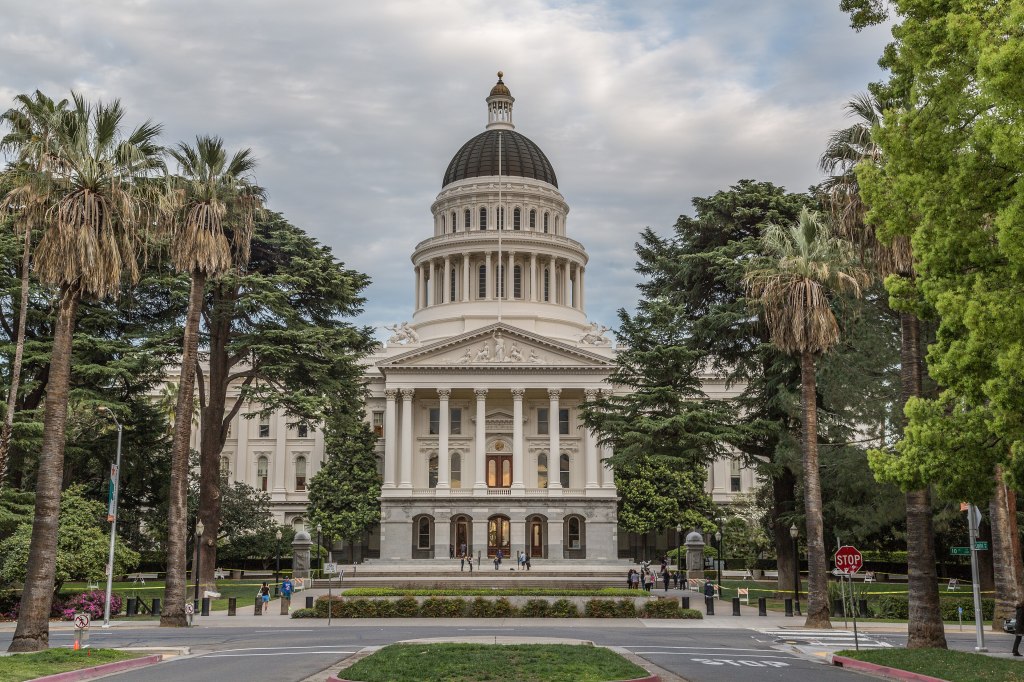
Top image: The California State Capitol in Sacramento, viewed from Capitol Mall. Photo: Tony Webster from Minneapolis, Minnesota, United States / CC BY-SA 2.0 via Wikimedia Commons
Eleven days before Election Day, a single committee financed largely by Silicon Valley’s wealthiest residents has become the dominant funder of California’s November ballot.
Building a Better California, committee No. 1486767, has contributed $321.65 million to six ballot measure campaigns, according to the Fair Political Practices Commission’s top-contributor lists, last updated Oct. 22. Of that, $304.65 million is aimed at three linked measures: Proposition 40, the one-time billionaire tax, and Propositions 41 and 42, which the state’s Legislative Analyst says could stop Prop 40 from taking effect if either receives more yes votes.
For voters in Santa Clara and San Mateo counties, this is a home-region story. The committee’s largest donors, as listed in state filings, include Google co-founder Sergey Brin, former Google chief executive Eric Schmidt and venture capitalist John Doerr. The tax it is fighting would fall on billionaires who were California residents on Jan. 1, 2026, and a large share of them live here.
What is on the ballot
The Legislative Analyst’s Office describes the three measures this way:
- **Prop 40** would impose a one-time 5% tax on the net worth of billionaires who were California residents on Jan. 1, 2026, due in 2027 with an option to pay over five years, with most of the money required to be spent on health care. The LAO estimates a temporary revenue increase of tens of billions of dollars spread over several years and a possible ongoing loss of less than $1 billion a year in income tax revenue if billionaires leave or reduce California income.
- **Prop 41** would nullify state taxes enacted after Jan. 1, 2026 whose revenues are excluded from the state spending limit, and would require State Auditor reviews of programs funded by new special taxes, according to the official ballot summary and the LAO.
- **Prop 42** would prohibit new state taxes on the ownership of financial assets or other personal property and limit retroactive taxes, nullifying conflicting taxes enacted after Jan. 1, 2026, the LAO says.
The critical sentence appears in the LAO’s analyses of both 41 and 42: if either “receives more ‘yes’ votes than Proposition 40 on this same ballot, then Proposition 40 could be stopped from becoming law even if it gets yes votes from a majority of voters,” because courts could find the measures conflict.
Where the $321.65 million went
According to the FPPC’s lists, Building a Better California has given:
- $127.8 million to Yes on 42 (Protect Retirement & Life Savings).
- $118.5 million to No on Prop 40.
- $58.35 million to Yes on 41 (Californians for Transparency and Accountability).
- $10 million to Yes on 45, which modifies environmental review.
- $6 million to Yes on 37, the Middle-Class Homeownership and Family Home Construction Act.
- $1 million to Yes on Prop 1, the Veterans and Affordable Housing Bond Act of 2026.
The ordering is the story. The committee has spent more to pass Prop 42 than to defeat Prop 40. Read alongside the LAO’s conflict language, the strategy is visible in the numbers: the campaign does not need to win the argument over Prop 40 outright. It can win by persuading more voters to say yes to 41 or 42 than say yes to 40. That is a Chronicle analysis of the public record, not a statement from the committee, which describes its measures in terms of protecting retirement savings and requiring audits.
How the money arrived
The Secretary of State’s Quick Guide to Propositions lists the ten largest contributions to each side, and the timing is revealing.
Building a Better California’s Prop 41 money came largely in the first half of the year: $16 million on Feb. 27, $10 million on March 13, $7 million on May 15 and smaller sums through spring, plus $10 million on July 24 and $5 million on Aug. 14, according to the Prop 41 guide.
The No on 40 money is a fall campaign. Its nine largest contributions from the committee arrived weekly from Aug. 20 through Oct. 16: $8.5 million, $7 million, $9 million, $12 million, $15 million, $17 million on Sept. 25, then $15 million on each of Oct. 2, Oct. 9 and Oct. 16. Those nine checks total $113.5 million.
The Yes on 42 money spans both periods, with $16 million on March 13 and a fall surge: $13 million on Sept. 21, $16 million on Sept. 28, $8 million on Oct. 2 and $15 million each on Oct. 9 and Oct. 16, according to the Prop 42 guide.
In the week ending Oct. 16 alone, the committee’s two largest reported contributions, $15 million to No on 40 and $15 million to Yes on 42, totaled $30 million.
The other side
The opposition is essentially one committee. Yes on 40 – Billionaire Tax Now – No on 41 & 42, sponsored by SEIU United Healthcare Workers West, appears on the FPPC lists for all three measures with the same top-contributor total: $32,386,200.51, almost all of it from SEIU-UHW and its affiliated committees. Smaller donors listed include Saikat Chakrabarti ($201,000) and Ross Boucher ($200,000).
That makes the money ratio on the 40-41-42 fight roughly 9.4 to 1: $304.65 million from Building a Better California against about $32.4 million from the union-backed committee’s top contributors. The union’s largest gifts, per the Quick Guide, came in January through April; its biggest single listed contribution is $2.35 million on March 10.
Other money is in the race. A separate committee opposing Prop 40, Golden State Promise, lists $5 million each from Ripple Labs and its co-founder Chris Larsen, and $450,000 from the California Business Roundtable’s issues PAC, per the FPPC. In all, the FPPC’s tally of top contributors opposing Prop 40 across committees is $129.2 million; Building a Better California accounts for about 92% of it.
Who funds the committee
The FPPC lists the committee’s “top donors to contributor” as Sergey Brin and L. John Doerr, III on most measures; on its Prop 37 entry it lists Brin and Eric Schmidt. A more granular picture comes from PubSys, a third-party site that republishes state Cal-Access filings. As of its latest data load, PubSys shows the committee raising $317.6 million from 66 donors across 104 contributions, with a median contribution of about $1 million. Its top donors:
- Sergey Brin, $102 million in seven contributions, the most recent July 24.
- Eric Schmidt, $40.24 million, most recently Oct. 7.
- John Doerr, $40 million, most recently Oct. 2.
- Patrick Collison, $33.17 million, most recently Oct. 2.
- Vinod Khosla, $12.56 million; Chris Larsen, $12.51 million; Michael Moritz, $7.5 million.
Further down are other prominent Peninsula and South Bay names, including Ram Shriram, Frank Slootman, Tony Xu, Max Levchin, Alfred Lin and David Baszucki.
The pattern matters. Brin supplied nearly a third of the committee’s money but, per PubSys, has made no new contribution since July 24. The fall surge has been financed by a widening group of Silicon Valley donors, which turns what began as one billionaire’s campaign into a broader class response.
Two cautions on the figures. PubSys’ receipts total ($317.6 million) is slightly lower than the FPPC’s outgoing total ($321.65 million) because the two sources update on different schedules; the FPPC list was updated Oct. 22, while PubSys reflects filings it had processed at its last update. Neither is a final accounting. And Cal-Access itself, the state’s official database, was not accessible to the Chronicle during reporting.
PubSys also lists contributions from Brin beyond this committee, including $3 million to a committee called JobsPAC and $1 million to a committee supporting San José Mayor Matt Mahan’s campaign for governor. The Chronicle has not independently reviewed those filings.
What supporters and opponents say
In the official ballot arguments summarized by the Secretary of State, Prop 40 proponents say “It’s time to make billionaires pay their fair share and stop sticking the middle class with the bill.” Opponents call it “a flawed, one-time tax scheme that hurts our economy, damages our state budget,” and list the California Teachers Association, California Medical Association and California Professional Firefighters among their allies. Listed opponents also include the California Primary Care Association, California School Boards Association and California Taxpayers Association.
Prop 41 supporters, including the California Society of CPAs and the California Taxpayers Association, argue that “Billions have flowed into programs like homelessness, with too little to show for it.” Prop 42 supporters, including the California Professional Firefighters and the State Building and Construction Trades Council, close their argument with: “You earned it. Prop. 42 protects it.”
The opposing arguments on both are pointed. On Prop 41: “it’s a billionaire-funded trick designed to undo the California Billionaire Tax.” On Prop 42: “its only real purpose is to undo the California Billionaire Tax.” Sen. Bernie Sanders and SEIU-UHW are listed as opponents of both.
Key dates for voters
- **Now through Nov. 3:** Vote-by-mail ballots can be returned by mail, at drop boxes or at vote centers.
- **Nov. 3:** Election Day. Mailed ballots must be postmarked by Election Day.
- **After Nov. 3:** Watch the yes-vote totals on 40, 41 and 42 relative to one another, not just whether each passes. Under the LAO’s analysis, the comparison could determine whether Prop 40 takes effect.
The long view
Whatever the outcome, this cycle has established a template. A single committee, funded by a few dozen of the region’s wealthiest people, can now outspend organized labor nearly ten to one and use the mechanics of the initiative process, not only persuasion, to shape results. If Prop 40 passes and survives, it will be the first state wealth tax of its kind and a test of whether billionaire residency can be taxed without being driven away. If it fails, or is displaced by 41 or 42, the constitutional barriers those measures erect would make similar proposals far harder for years. Either way, the Peninsula and South Bay will have financed the decisive side of the argument.
Sources
- FPPC: Top 10 contributors, November 2026 General Election (updated Oct. 22, 2026)
- Secretary of State Quick Guide: Proposition 40
- Secretary of State Quick Guide: Proposition 41
- Secretary of State Quick Guide: Proposition 42
- Legislative Analyst’s Office: Proposition 40
- Legislative Analyst’s Office: Proposition 41
- Legislative Analyst’s Office: Proposition 42
- PubSys CalAccess: Building a Better California (committee 1486767)


Leave a Reply