
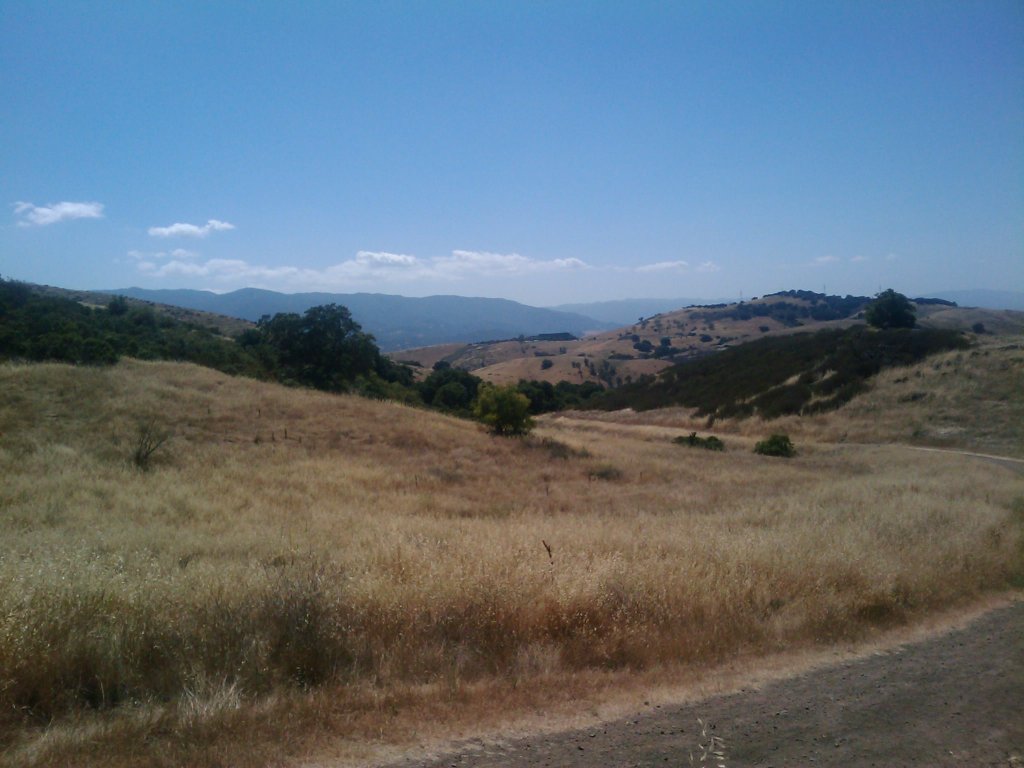
Top image: Grassland hills looking toward IBM’s Almaden Research Center campus in south San José. Photo: phxhawke / CC BY-SA 3.0 via Wikimedia Commons
At a neighborhood association meeting in south San José last week, Mayor Matt Mahan made a striking admission about one of the city’s most beloved stretches of open hillside. When IBM built its Almaden Research Center, he said, “they said that they intended for the open space to be in perpetuity. But … they never created any legally binding easement. Now there is a new owner… we are going to push them as hard as we possibly can to actually adopt a permanent conservation easement.”
That quote, reported by San José Spotlight, compresses a 27-year paper trail into a sentence. The Chronicle reviewed the city’s own records for the August rezoning of 650 Harry Road, including the staff report, the rezoning ordinance and its legal descriptions, and public correspondence that attached the City Council’s December 1999 minutes. Together they show how roughly 565 acres of serpentine grassland above Almaden Valley went from “permanent open space” in a 1980 planning document to land whose long-term protection now rests on negotiations with a data center developer.
Document one: the 2026 staff report
The council’s August action is Legistar File 26-850, agenda item 10.1(a) for Aug. 18. The staff report, dated Aug. 7 and covering files C26-008 and ER26-088, describes a “conforming rezoning” of a 600.16-gross-acre site at 650 and 20500 Harry Road. The applicant is 650 Harry Road LLC; the application was filed June 8 by land use consultant Erik Schoennauer.
The rezoning replaced a 1980 Planned Development zoning (File PDC80-165), which allowed research and parking uses on about 36 acres, recreation on 4 acres and open space on the remainder, with two conventional districts: IP Industrial Park on roughly 35 acres (the legal description attached to the ordinance specifies 35.097 acres) and OS Open Space on roughly 565 acres.
Three lines in the staff report carry most of the weight. First: “There is currently no application on file for the development of the site.” Second: the rezoning “would allow a broader range of uses than those permitted by the existing Planned Development Zoning District.” Third, on environmental review, the city relied on a determination of consistency with the Envision San José 2040 General Plan environmental impact report and its supplement, rather than a new project-level study. The logic is legally conventional. The zoning was being aligned with land use designations the city adopted years ago, so no new analysis was required. But it also means the rezoning was evaluated without reference to any specific future use.
The council approved it 9-2, with Councilmembers Rosemary Kamei and Pamela Campos opposed, Spotlight reported. “We’re not actually having a conversation about data centers right now,” said Councilmember George Casey, whose District 10 includes the site. “This is a step toward that, I want to acknowledge that.”
Document two: the 1999 minutes
The deeper history surfaced in a letter to the council’s Rules Committee from resident Evan Brooks, filed in the File 26-850 record, which attached the minutes of the Dec. 7, 1999 council meeting.
Those minutes record that IBM’s land had been the subject of a 1998 request, GP98-10-1, to redesignate 36.5 acres east of Harry Road, north of Arroyo Calero Creek, from Private Open Space to Low Density Residential. Staff and the Planning Commission recommended no change. Councilmember Pat Dando’s memo, cited in the minutes, asked the council to deny the amendment and to “Direct Staff to work with IBM and open space organizations to pursue a legally binding agreement that will permanently protect the 540 acres of open space surrounding the Almaden Research Center,” and to develop a process for open space easements or covenants.
The minutes capture Mayor Ron Gonzales framing the stakes: the questions were “whether to allow development within the Greenbelt and whether to hold a company to a promise made in the past.” He said he was “convinced given the documentation that a promise was made and Council should hold IBM to that promise.” The motion carried 10-1, with Councilmember Diquisto dissenting.
Brooks’ letter makes the central claim: “That directive was never carried out — no easement, deed restriction, or other recorded instrument was ever put in place.” The Chronicle has not independently searched county recorder files to confirm the absence of any recorded instrument. But the mayor’s own statement, quoted above, is consistent with that account, and the 2026 staff report does not identify any recorded easement on the open space portion.
Note the drift in acreage across the documents: 540 acres in 1999, about 565 acres in the 2026 rezoning, and “approximately 570 acres” in Brooks’ letter. The differences likely reflect surveys and how the developed area is drawn, but they illustrate a point. Without a recorded instrument with a legal description, even the size of the protected land is a matter of interpretation.
Document three: the buyer’s own words
Within six weeks of the vote, the buyer emerged. Blackstart Digital, which describes itself as a data center development and investment firm, has agreed to acquire the property, with closing expected by year’s end, Spotlight reported Oct. 1, citing Schoennauer, who represents both 650 Harry Road LLC and Blackstart. The campus has seven buildings totaling more than 500,000 square feet within the 35-acre industrial area.
The company’s description of the site is precise. “The campus is served today by an on-site 25-megawatt substation and houses multiple generations of preexisting data center facilities where we intend to expand capacity, subject to power availability,” a spokesperson told Spotlight. The company said it does not intend to develop the surrounding open space. The Real Deal, citing documents filed with city planners, reported that Blackstart has filed for environmental review of renovations with a July 2028 target for a hearing and potential decision.
City planning spokesperson Marika Krause told Spotlight that Blackstart asked the city in June to finish environmental review to wrap up the rezoning, and that no other application had been filed.
The disputed timeline
Not everyone accepts that the August vote was routine housekeeping. Bob Staedler, a land use consultant who writes The Synergy Report, has argued the council was not told the full context. He writes that Blackstart Infrastructure Partners and partners were photographed at the campus discussing AI and data centers in an April 27 social media post; that the city’s environmental review file ER26-088 was opened June 2 and connected to Blackstart Digital; and that by September Blackstart’s website was marketing 650 Harry Road as a flagship AI-compute campus with a path to 220 megawatts, before the site was taken down Sept. 25. Staedler calls the omission materially misleading. The Chronicle has not independently verified the website contents he describes. His account and the staff report agree on one point: no formal data center application existed when the council voted.
Separately, a joint letter from the Sierra Club, California Native Plant Society and Mothers Out Front warned that Senate Bill 131 exempts certain advanced-manufacturing facilities on industrially zoned land from CEQA review, according to Spotlight. Shani Kleinhaus of the Santa Clara Valley Bird Alliance put it bluntly: “The rezoning may let industry avoid CEQA, leaving the community to bear the environmental and public health costs.”
What the land is
Alice Kaufman, policy and advocacy director at Green Foothills, told Spotlight the open space is predominantly serpentine grassland, habitat for rare native plants and for plants essential to the threatened Bay checkerspot butterfly. Serpentine grassland is particularly vulnerable to nitrogen deposition, she said, which is why diesel backup generators, a standard feature of data centers, are a specific concern. She said the city’s zoning code holds a data center next to open space only to the weakest noise standard in the municipal code. “It’s important open space. It’s part of our regional wildlife corridor,” she said, adding that the ideal outcome would be deeding the land to an open space district or habitat agency.
Where the parties stand now
Mahan told Spotlight he is working with Casey on permanent protections. “I don’t think we want to see an expanded footprint,” he said. He also said he wants San José to have “the strictest (data center) standards in the country,” including 100% clean energy and recycled water or closed-loop cooling.
Schoennauer said the company looks forward to working with the mayor and Casey “to determine the best approach to accomplish this goal,” adding: “Our project proposes to only use the existing 35 acres of developed industrial park land.” Casey did not respond to Spotlight’s requests for comment.
Analysis: leverage, then and now
The documents point to an uncomfortable conclusion. In 1999, the city had maximum leverage. IBM wanted a General Plan change, and the council could have conditioned it on an easement. Instead it denied the request and asked staff to pursue an agreement later, which the record indicates never came. In 2026, the council again held leverage: an owner preparing a sale wanted conventional zoning that, in Schoennauer’s words to the council as quoted by Staedler, would provide “a logical and predictable process with no risks or roadblocks.” The council granted the rezoning without securing an easement.
What remains is softer leverage. Blackstart will need discretionary approvals for any significant expansion, power upgrades from the utility and goodwill from neighbors. The city’s forthcoming data center standards, which the Rules Committee directed in June and which are due back to the council in December, according to Brooks’ letter, are another lever. The Chronicle has reported on the parallel power buildout in North San José that is shaping data center siting citywide.
An easement offered voluntarily by a buyer before closing would be a meaningful outcome. It would also be a reversal of how land use protection normally works: a permanent public benefit secured by private generosity rather than public condition.
What’s next
- **Before year-end:** Blackstart’s acquisition is expected to close, per Schoennauer. Any easement negotiated before closing would bind the new owner.
- **December 2026:** Citywide data center and large-energy-use standards are due to the council.
- **2027–2028:** Environmental review of renovations, with The Real Deal reporting a July 2028 hearing target.
The long view
The Almaden hills are a test of whether Silicon Valley’s past promises survive its next economy. IBM’s lab was a product of the research-campus era, when corporate landowners could afford to leave hundreds of acres untouched. The AI era values the same parcel for a different reason: an existing 25-megawatt substation and buildings ready for compute. San José wants both the tax base and the greenbelt. The lesson of 1999 is that intent is not protection. Only a recorded instrument is.
Sources
- City of San José Legistar: File 26-850, staff report (Aug. 7, 2026), ordinance, legal descriptions and public correspondence including Dec. 7, 1999 council minutes
- San José Spotlight: Will San Jose protect 500+ acres around former IBM site?
- San José Spotlight: Rezoning of San Jose IBM site raises environmental concerns (Aug. 26, 2026)
- San José Spotlight: Data center company to acquire former South San Jose IBM site (Oct. 1, 2026)
- The Real Deal: Blackstart Digital buys former IBM campus in San Jose
- The Synergy Report: What Was the City Council Told About 650 Harry Road?


Leave a Reply