
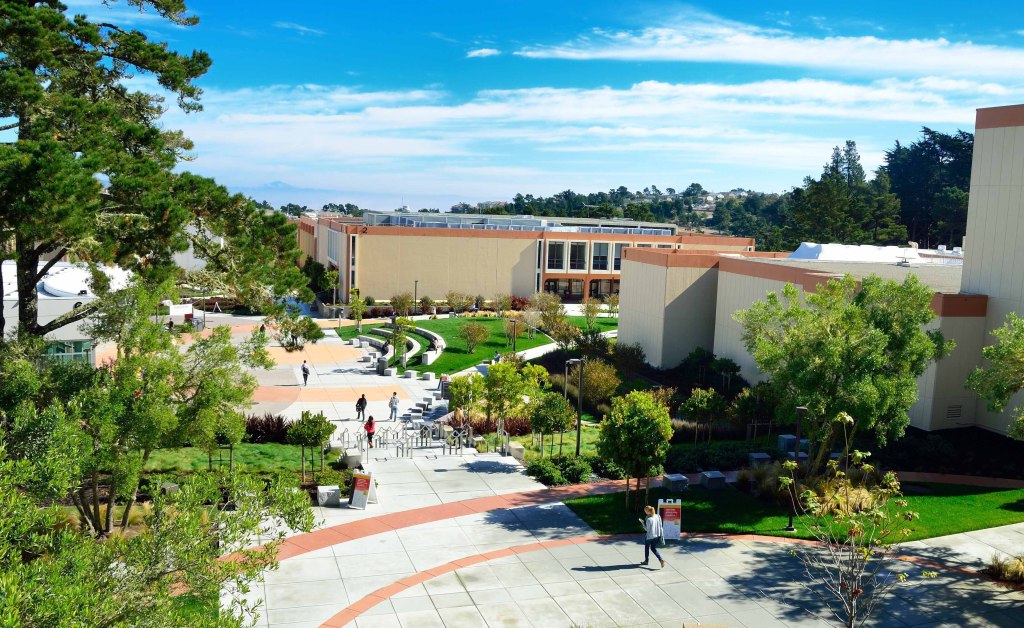
Top image: Skyline College’s campus and main quad in San Bruno. Photo: Skyline College / CC BY-SA 4.0 via Wikimedia Commons
Of the dozens of local measures on San Mateo County ballots, one reaches every voter in the county and touches three campuses that train much of the Peninsula’s workforce. Measure V would authorize the San Mateo County Community College District, which runs College of San Mateo, Cañada College in Redwood City and Skyline College in San Bruno, to issue up to $848 million in general obligation bonds. It needs 55% of the vote on Nov. 3.
What a yes vote does
According to the League of Women Voters of South San Mateo County’s summary of the measure, drawn from the county’s official election materials, the district’s best estimate of the highest annual tax rate is $18 per $100,000 of assessed value, about $75 million a year. The bonds are expected to be repaid by June 2049, and the district estimates total repayment, principal plus interest, at about $1.35 billion.
The ballot question begins, “Without increasing current tax rates,” a phrase that is accurate and incomplete. As the Bay Area Brief summarized reporting by Skyline’s student newspaper, the measure extends an existing rate rather than adding a new one. In practice, a yes vote postpones a drop in property taxes that would otherwise come as older bonds are paid off. The student paper’s estimate was about $390 a year on the county’s median house, according to that summary; the Chronicle could not independently verify that figure.
What it would build
The project list, as summarized by the League, includes:
- Districtwide infrastructure upgrades, computer labs and traffic management.
- Cañada College: modernized fine arts facilities.
- College of San Mateo: a modernized maintenance center, library and gymnasium.
- Skyline College: a modernized library, a new athletic center and a modernized visual and performing arts center.
The measure requires an independent citizens’ oversight committee, a separate account for bond money and annual performance and financial audits, according to the League.
At Skyline, the biggest single need is Building 1, the campus’s 1969 fine arts building, according to the Bay Area Brief’s summary of the student paper’s reporting, which described water pooling by the boiler, a roof that ponds and flooding beneath the theater stage, and a district presentation counting 188 accessibility barriers in that building alone.
The arguments
Supporters, according to the League’s summary of the official ballot arguments, say the measure keeps the current tax rate, provides local funding the state and federal government cannot redirect, and repairs buildings that are more than 50 years old and in some cases contain asbestos or lead pipes. They note that 42% of local high school graduates choose the district’s colleges and that the campuses train nurses, firefighters and skilled workers. Signers in favor include representatives of the San Mateo Community College Federation of Teachers, San Mateo County firefighters, the Central Labor Council and the Silicon Valley Community Foundation.
Opponents, whose signers include Mark W.A. Hinkle of the Silicon Valley Taxpayers Association, call it the district’s fifth bond request since 2001, adding $848 million on top of more than $1.1 billion already approved. They argue past bond money went to administrative offices, private event spaces and health clubs at CSM and Cañada, that enrollment is flat as online learning grows, and that extending a tax rate is “still a tax increase” over the longer term. They also say the oversight committee reviews spending only after the fact.
Chris Robell, a Silicon Valley Taxpayers Association board member who signed the argument against, told the student paper that the three campuses’ facilities “are among the finest facilities I’ve ever seen,” and said his group would support a bond limited to seismic hazards or leaking roofs, according to the Bay Area Brief.
Full ballot text, the impartial analysis and arguments are posted on the San Mateo County elections office’s Nov. 3 page.
How to read it
Measure V shares the ballot with a long list of local taxes and bonds, plus the regional transit sales tax, Measure RTM. For voters, the core question is less “new tax or not” than whether to keep paying at today’s rate for another generation of buildings, and whether they trust the district’s track record on how past bond dollars were spent.
The long view
Community colleges are the Peninsula’s most direct pipeline from high school into health care, public safety and the trades, and their buildings were largely designed for a 1960s economy. The district is asking voters to finance the next 25 years of that pipeline in a single vote. Whatever the outcome, the debate over Measure V previews a broader one across the region: aging public facilities, high construction costs and voters weighing repeated borrowing against the cost of letting infrastructure decay.
Sources
- League of Women Voters of South San Mateo County, Measure V summary, November 2026
- San Mateo County Assessor-County Clerk-Recorder & Elections, November 3, 2026 Statewide General Election
- Bay Area Brief, “San Mateo County Community College District Measure V Explained,” Oct. 21, 2026


Leave a Reply