
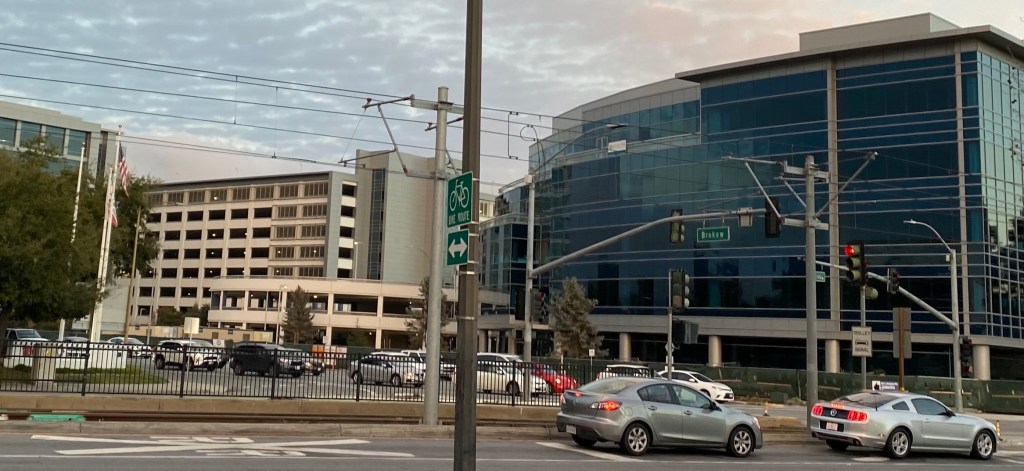
Top image: Office buildings at Brokaw Road and North First Street in North San Jose. Photo: Cristiano Tomás / CC BY-SA 4.0 via Wikimedia Commons
The most consequential real estate in Silicon Valley may now be the land next to a substation. Three files moving through San Jose City Hall this month, all in North San Jose, show how the AI build-out is reshaping the city’s industrial core. On Tuesday, the City Council upheld data center use inside an Nvidia-leased building on Holger Way. Next week, the Planning Commission takes up an amendment to Apple’s long-standing development agreement that would carve out 9.7 acres for a PG&E substation. And half a mile from that site, Prologis is seeking approval for a 99-megawatt data center.
Holger Way: a “data center” that is really a lab
The council voted 8-0 on Oct. 20 to deny an environmental appeal and uphold the planning director’s approval of data center use at 300 Holger Way, The Mercury News reported. According to the council file, the project allows a data center use inside an existing 97,800-square-foot research and development building on a 4.86-acre site west of Zanker Road, and relied on California’s in-fill exemption from full environmental review.
Nvidia leased the building for 10 years and has spent more than $100 million remodeling it for testing and research on its computer systems, Jane Vaughan of owner Menlo Equities told the council, according to the Mercury News. The appeal came from Citizens for Responsible Industry, whose attorney argued the city was “piecemealing project approvals.” Councilmember David Cohen said the debate concerned “a building that is not a data center,” adding that the city has “a very strange definition of data center in our city code.” Three council members did not vote, including Vice Mayor Pam Foley, who cited a financial interest in Nvidia, the paper reported. Vaughan said Nvidia is looking for additional space in San Jose.
Apple’s land, PG&E’s substation
The second file is quieter and potentially larger. In a public notice posted Oct. 16, the city described an amendment to the development agreement covering Apple’s roughly 86.73-acre site on both sides of Orchard Parkway, west of North First Street and east of the Guadalupe River. The amendment would remove 9.7 acres that Apple intends to convey or sell to PG&E, “which PG&E intends to use for the construction and operation of a substation, separate from the subject project.”
The same amendment would vacate Orchard Parkway between Component Drive and Atmel Way, about 1.7 acres, and all of Atmel Way, about 1.3 acres, closing both to through traffic and folding roughly three acres of former public streets into the land available for Apple’s private use. In exchange, the notice lists Class IV protected bike lanes on Component Drive. The Planning Commission hearing is set for Oct. 28, followed by the City Council. The substation itself is a separate project; state regulators, not the city, are the main decision-makers on PG&E infrastructure, according to a CiVL summary of the Mercury News report that first described the plan.
The 99-megawatt neighbor
The power question is the thread that ties these files together. Prologis has applied for a special use permit to demolish five buildings at 326 Charcot Ave. and build a three-story data center of about 514,000 square feet, according to the city’s data center applications list, where environmental review is listed as under the California Energy Commission. The San Jose Blog, citing the Mercury News, reported the design power at 99 megawatts and said the grid connection would run through PG&E’s Trimble substation on Component Drive, with Prologis paying for switchgear and transmission upgrades. Nothing there is entitled yet.
The city’s list, last updated Sept. 14, shows 11 data center applications under review, plus a 250-megawatt research and development project on Disk Drive classified as a “large energy-use project” rather than a data center. That distinction, between renting out servers and using enormous power for a company’s own work, is the one Cohen called strange.
Why this is a real estate story
North San Jose was zoned and rezoned for two decades around the idea of office campuses and, later, housing. Apple bought its Orchard Parkway land years ago with approval for millions of square feet of offices and labs, according to CiVL. What the new filings suggest is that the scarcest input has changed. A parcel’s value increasingly depends on its distance from transmission capacity, and a utility substation can be the anchor tenant that makes surrounding industrial land viable for compute. The uniform data center standards the city is drafting, due before year’s end, will decide how much of that land converts. As the Chronicle’s review of five local rulebooks found, policy is being written one jurisdiction at a time; meanwhile, approvals continue permit by permit.
The long view
The Valley’s last great land transformation turned orchards into fabs and fabs into office parks. The next one is being decided in filings most residents will never read: development agreement amendments, street vacations and CEQA exemptions. The council’s frustration with its own definitions is a sign that the code was written for an earlier economy. If San Jose wants the tax base and jobs that compute brings without surrendering its housing ambitions in North San Jose, it will need rules that treat power as the land-use issue it has become, and a clearer public accounting of what each substation makes possible next door.
Sources
- City of San José, Public Draft Review: Orchard Parkway Development Agreement Amendment and Street Vacation Project Addendum, Oct. 16, 2026
- City of San José, File 26-1082, appeal of in-fill exemption for 300 Holger Way
- City of San José, Data Center and other Large Energy-Use Projects, updated Sept. 14, 2026
- The Mercury News via SiliconValley.com, “Proposed data center in San Jose building used by Nvidia gets final city approval”, Oct. 21, 2026
- CiVL News, “PG&E plans substation on 9.7 acres from Apple in North San Jose”
- The San Jose Blog, “Prologis Files for a 99-Megawatt Box at Charcot and Zanker”, Oct. 10, 2026


Leave a Reply