
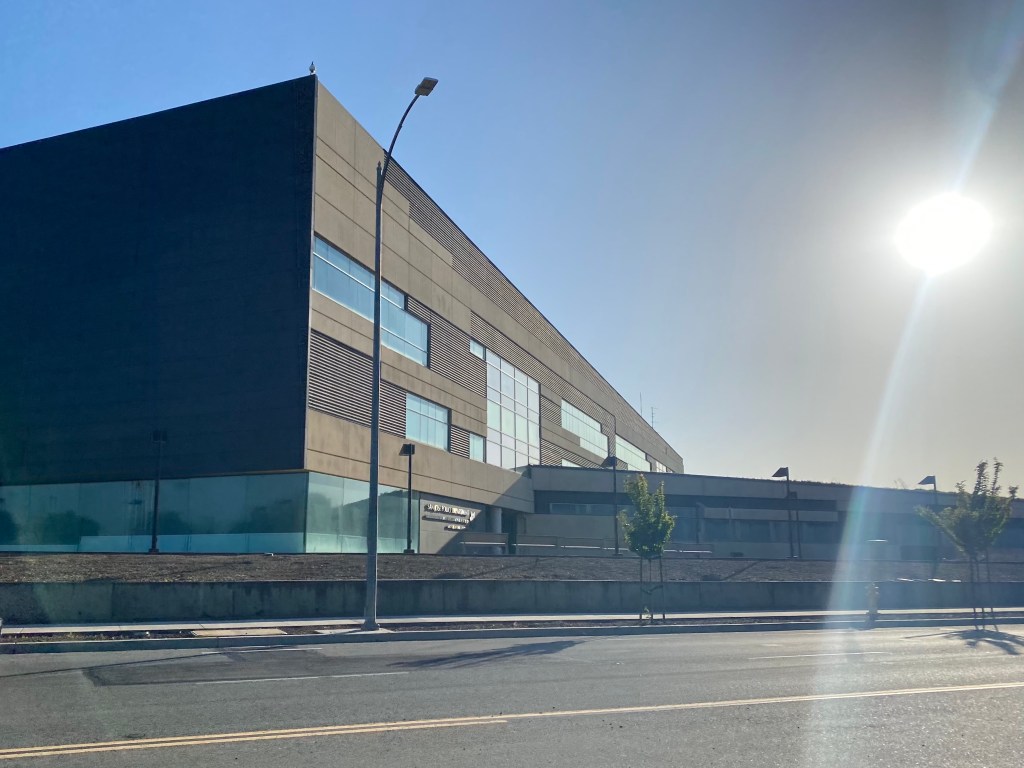
Top image: The San Jose Police Department’s Southern Police Station. Photo: Cristiano Tomás / CC BY-SA 4.0 via Wikimedia Commons
San Jose police used force 598 times in 2025, the fourth consecutive annual increase since a 2021 low, according to the 2025 annual report of the city’s Office of the Independent Police Auditor, presented to the City Council on Tuesday. The figure is up about 5% from 569 in 2024, though still below the 715 incidents recorded in 2020, the report shows.
The more telling line may be one about the auditor’s own reach. Of those 598 incidents, the office says it does not receive the reports, body-worn camera footage and other evidence needed for case-level review of the 582 that did not involve great bodily injury. “Statistical review can identify changes in frequency, but it cannot independently explain why force increased,” the report says, adding that this “does not establish that the increase was improper.”
The numbers
According to the report, presented by Interim Police Auditor Dwight White:
- Community complaints rose 24%. Complaints from the public reached 326, the highest in the five-year span shown, after falling from 273 in 2021 to 224 in 2023.
- Bias-based policing allegations rose by more than 40%, with none sustained.
- The office audited and closed 330 cases and attended a record 172 Internal Affairs interviews. Of 942 allegations closed, 102 were sustained, an 11% sustained rate.
- Serious-force and critical incidents rose to 20, including three officer-involved shootings and one in-custody death, the first increase after three years of declines.
- One officer drew seven complaints, the most in the department.
White told the council that more allegations do not necessarily mean more misconduct, San José Spotlight reported. “Nevertheless, the trends do help us identify areas where additional training, clearer policies or better communication may be beneficial to the public,” he said.
One note on the trend: an overview page of the report describes the 2025 increase as “the first interruption of the longer-term decline from the 2020 high,” while its detailed chart and text call it the fourth consecutive annual rise after 2021. The year-by-year figures in the chart, 467 in 2021, 544 in 2022, 548 in 2023, 569 in 2024 and 598 in 2025, support the latter.
A license plate case at the center
The first of the auditor’s 12 recommendations grows out of a case the city has already reckoned with. The report describes an off-duty officer who used a personal phone to run multiple Flock license plate queries tied to a domestic violence matter involving a relative, located the victim, shared her location with the relative who was the suspected aggressor, and later deleted the communications. The allegations were sustained and discipline imposed, but the report says no rule at the time barred access to license plate reader data from personal devices.
The department’s written response says it issued Department Memo 2026-029 on Sept. 8, prohibiting the use of personal or non-city devices to access law enforcement databases including Flock, with a Duty Manual revision due by Dec. 31. It is the latest chapter in a debate the Chronicle has followed, from a judge’s ruling upholding the city’s camera network to the county’s surveillance ledger.
Other recommendations range from training on the limits of cell phone “ping” location data, after officers searched a home based on a ping with an uncommunicated two-mile radius, to written guidance on when officers may order passengers out of cars during routine stops. In one audited case, an officer asked, “Why did we stop them if we are not going to pull them out of the car?” before occupants were ordered out without documented safety concerns.
What the department accepted
Chief Paul Joseph’s memo says the department agrees or partially agrees with most of the recommendations. It agreed to give the auditor every completed great bodily injury and officer-involved shooting investigation, with access to the underlying evidence, within 30 days of a final decision, a long-standing request. It partially agreed on a proposed ban on profanity as a de-escalation tactic, arguing existing courtesy rules were enough to sustain allegations in the cited cases. Most changes carry projected completion dates between December and February.
“We’re always trying to be better,” Joseph told the council, according to San José Spotlight. Mayor Matt Mahan said transparency supports public safety: “If people don’t trust the department and City Hall more broadly, they’re less likely to report crime, share evidence or serve as witnesses.”
The report arrives with the office in transition. White became interim auditor after Eddie Aubrey retired in September without a public explanation, San José Spotlight reported. The report also notes the office stopped automatically responding to officer-involved shooting scenes in early 2026, saying it is “not granted access to the scene” or briefings.
The long view
San Jose’s civilian oversight model was built in 1993 around auditing complaints after the fact. The 2025 report shows its limits in a department where most force never generates a complaint and the auditor sees statistics rather than footage. The ALPR case shows the other pressure: surveillance tools spread faster than the rules that govern them. Whether the department’s 30-day evidence pledge is honored, and whether the council expands the auditor’s access beyond serious-injury cases, will determine if oversight keeps pace with a police force that is using more force and more data at the same time.
Sources
- City of San José Office of the Independent Police Auditor, 2025 Annual Report (Council File 26-1078)
- San José Police Department, Response to the Policy Recommendations from the 2025 IPA Year End Report, Sept. 28, 2026
- San José Spotlight, “San Jose police use of force cases continue to rise”, Oct. 21, 2026


Leave a Reply