
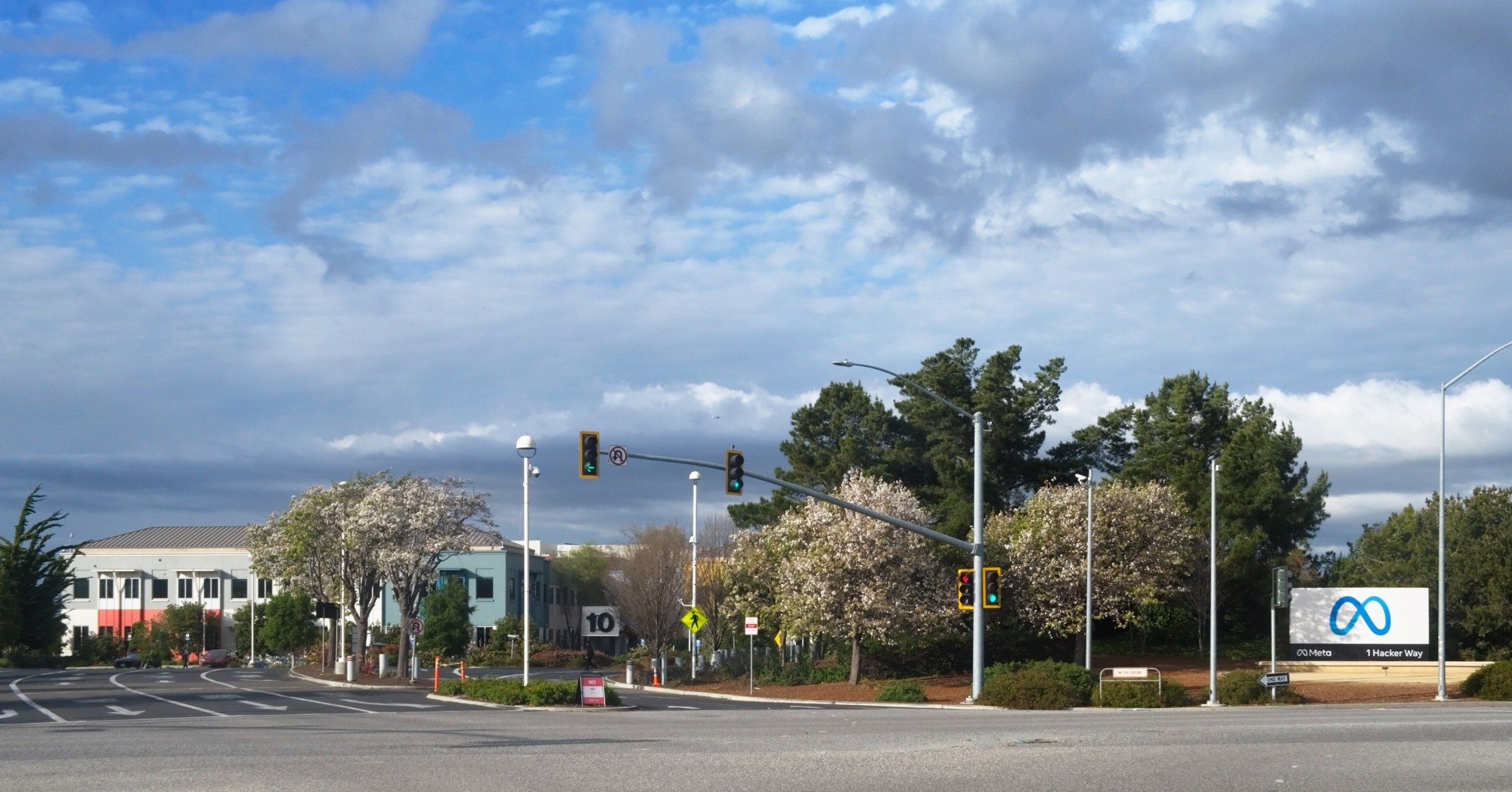
Top image: The entrance sign at Meta Platforms’ headquarters in Menlo Park, March 2022. Photo: LPS.1 / CC0 via Wikimedia Commons
For most of its two decades as a public company, Meta Platforms has been a machine that throws off more cash than it can spend. On Monday it asked investors for some back. The Menlo Park company announced the launch of two concurrent securities offerings that together total roughly $35 billion, an unusually large equity raise for a company of its profitability, and one that says a great deal about the economics of the artificial intelligence build-out now reshaping Silicon Valley’s largest companies.
The structure, laid out in Meta’s announcement and in an automatic shelf registration statement (Form S-3ASR) filed with the Securities and Exchange Commission, and read against the company’s quarterly report for the period ended Sept. 30, shows a company deliberately choosing equity over more debt as it finances a capital program that has outgrown even its formidable cash generation.
What Meta is selling
The first piece is 250 million depositary shares, each representing a one-twentieth interest in a share of a new Series A Mandatory Convertible Preferred Stock with a $1,000 liquidation preference. At $50 per depositary share implied by that ratio, the tranche comes to about $12.5 billion. The preferred is scheduled to convert into common stock on or about Aug. 15, 2029, and Meta said it would apply to list the depositary shares on Nasdaq under the symbol “METAM.” Underwriters have an option to buy up to 37.5 million additional depositary shares.
The second piece is $22.5 billion of Class A common stock sold in connection with forward sale agreements with affiliates of Morgan Stanley and Goldman Sachs, the deal’s lead bookrunners. In a forward structure, the banks borrow and sell shares now, while Meta delivers shares and receives cash later. The announcement states that Meta will not initially receive any proceeds from the common-stock offering, and that settlement must occur by Nov. 19, 2027. Underwriters have an option on up to $3.375 billion more.
Meta also disclosed a plan for a much larger, slower channel: an at-the-market program of up to roughly $60 billion of its forthcoming nonvoting Class C stock, which it said would not begin before the first quarter of 2027. And it said three of its largest suppliers, Nvidia, AMD and Broadcom, had indicated non-binding interest in buying up to $5.0 billion in the offerings as cornerstone investors. Indications of interest are not commitments, and the announcement says as much.
Why now: the numbers in the 10-Q
The quarterly filing makes the case more plainly than any press release. Capital expenditures for the first nine months of 2026 were $83.06 billion, up from $48.31 billion a year earlier. Third-quarter capex alone was $34.91 billion. Meta has guided full-year 2026 capex to $135 billion to $145 billion, which implies fourth-quarter spending well above anything it has done before.
Operating cash flow over the same nine months was $96.87 billion. That is a very large number, but once dividends and the existing capex run-rate are set against it, there is little left for a program of the size Meta describes. The company has already stopped repurchasing shares this year: the 10-Q shows no buybacks in 2026, compared with $26.25 billion in the first nine months of 2025, with $25.03 billion of authorization still unused. It has also leaned on credit. Long-term debt stood at $80.92 billion at quarter-end, up from $58.74 billion at the end of 2025, a jump that includes $25 billion of notes sold in May.
The longer-dated obligations are larger still. The filing lists leases signed but not yet commenced of about $355.73 billion, largely data center capacity, and total non-cancelable contractual commitments of $454.52 billion. It also discloses $14.72 billion of contingent commitments for cloud capacity. Those figures, more than the quarterly capex number, explain why a company with about $82 billion of cash and Aa3/AA- credit ratings, as cited in the announcement, would choose to issue equity: the commitments are long, and equity does not have to be refinanced.
A strong quarter, with one large charge
None of this reflects a business in trouble. Meta’s announcement summarized third-quarter revenue of $64.6 billion, up 26% from a year earlier, and net income of $9.9 billion. The company says its apps reach 3.64 billion daily users, and it describes data center operations in 23 states, including four “superclusters” exceeding a gigawatt each.
The 10-Q shows why profit looks thinner than revenue growth would suggest. Operating margin fell to 27% from 49% in the year-ago quarter, and diluted earnings per share came in at $3.83. The biggest single factor was a $9.89 billion charge tied to the multistate attorneys general agreement reached in August. Excluding that item, margins would have been meaningfully higher. Headcount at quarter-end was 66,775, and the board maintained a quarterly dividend of $0.525 per share.
The governance layer
The offering lands one week after Meta reorganized its share structure. In an Oct. 19 Form 8-K, Meta disclosed that its board, on the unanimous recommendation of a special committee of independent directors, approved a new class of nonvoting Class C common stock, approved by shareholders by written consent on Oct. 20. The board declared a one-time dividend of one Class C share for each Class A and Class B share, contingent on the restated charter taking effect, expected Jan. 19, 2027.
The same filing describes a “Founder Alignment Agreement” with Mark Zuckerberg, the company’s founder, chairman and chief executive. Under it, 20% of the Class C shares he receives will be freely saleable; the remaining 80% can generally be sold only if he sells or converts a matching voting share, so that he cannot cash out most of the new stock without a corresponding reduction in voting power.
The S-3ASR spells out the capital structure that frames the new securities: 5 billion authorized Class A shares, 4.141 billion Class B shares and 100 million shares of preferred. Class B shares carry 10 votes each, and a change of control requires approval of a majority of Class B holders until Class B represents less than 35% of total voting power. As of the 10-Q, about 2.214 billion Class A and 342 million Class B shares were outstanding. The Class C ATM program, once it starts, would allow Meta to raise equity over time without diluting voting control, which is precisely the design the new class appears built for.
How the market may read it
For shareholders, the near-term question is dilution against return on capital. A mandatory convertible carries a dividend and converts into common stock on a fixed schedule, so the dilution is deferred but certain. The forward sale delays both the cash and the share issuance, giving Meta flexibility through late 2027. The cornerstone interest from chipmakers is notable in its own right: suppliers that sell Meta the accelerators and networking gear it is buying would, if they participate, also become holders of its equity. That circularity in AI financing has drawn growing scrutiny across the industry, and the non-binding nature of the indications means investors will want to see final allocations.
The broader debate is whether returns on AI infrastructure will arrive before depreciation catches up. Meta’s own guidance implies fourth-quarter capex of roughly $52 billion to $62 billion, by subtracting the nine-month total from the full-year range, and the company’s next quarterly report will show whether it hit that pace.
The long view
Meta’s raise is a marker in the AI cycle. For a decade, the largest technology companies funded growth almost entirely out of operating cash flow and returned the surplus through buybacks. Meta has now paused buybacks, added about $22 billion of long-term debt this year alone, and turned to the equity market with a structure that preserves founder control while inviting suppliers onto the shareholder register. That is what a capital-intensive industry looks like, closer to utilities, telecom and semiconductors than to the asset-light software business Facebook once was.
For the Bay Area, the implications run in both directions. The spending flows largely to data centers in other states and to chipmakers headquartered here, including Nvidia, AMD and Broadcom. Whether the bet pays off will determine not just Meta’s share price but how much of the Valley’s next decade is financed by capital markets rather than profits.
Sources
- Meta announcement of depositary-share and forward-sale offerings, Oct. 26, 2026 (via PR Newswire)
- Meta Platforms Form S-3ASR, filed Oct. 26, 2026
- Meta Platforms Form 10-Q for the quarter ended Sept. 30, 2026
- Meta Platforms Form 8-K, Oct. 19, 2026 (Class C recapitalization and Founder Alignment Agreement)






Leave a Reply