
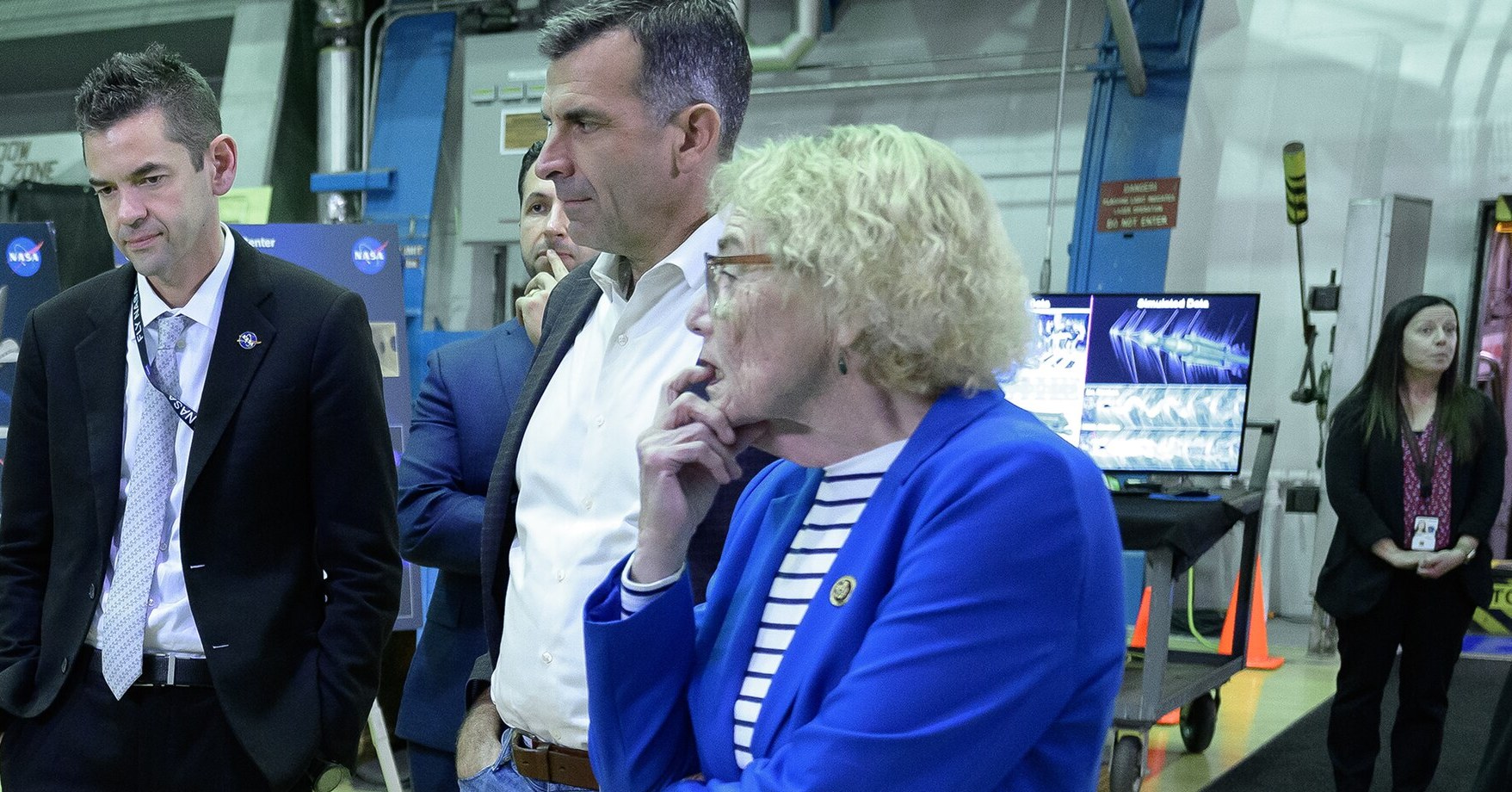
Top image: Rep. Zoe Lofgren, right, with Rep. Sam Liccardo and NASA Administrator Jared Isaacman during a Jan. 26, 2026, visit to NASA Ames Research Center in Mountain View. Photo: NASA Ames/Brandon Torres (public domain) via Wikimedia Commons
A bipartisan bill to put $10 billion into commercializing fusion energy has picked up four more House cosponsors since it was introduced last month, including Silicon Valley Rep. Ro Khanna, according to congress.gov. Khanna, who is weighing a 2028 presidential bid, is widely seen as a likely contender for the 2028 Democratic presidential nomination.
Rep. Zoe Lofgren of San José, the top Democrat on the House Science, Space, and Technology Committee, introduced the American Leadership in Fusion Act, H.R. 10574, on Sept. 24. Her lead Republican partner is Rep. Jay Obernolte, R-Calif., who chairs the committee’s Research and Technology Subcommittee. Reps. Don Beyer, D-Va., Lori Trahan, D-Mass., and James Gallagher, R-Calif., signed on the same day. Since then Reps. Janelle Bynum, D-Ore., Khanna, D-Calif., Josh Gottheimer, D-N.J., and Sharice Davids, D-Kan., have joined. Davids signed on Oct. 22. The bill has been referred to the Science Committee and has not had a hearing or markup.
What the bill would do
According to a fact sheet from Lofgren’s committee staff, the $10 billion would be split this way:
- $3.8 billion to build major new test facilities for fusion materials and fuel-cycle problems, including a fusion neutron source
- $300 million for small and mid-sized test facilities
- $800 million for fusion materials and fuel-cycle research
- $100 million to build supply chains for critical fusion technologies
- $2 billion for the Energy Department’s existing milestone-based program, which pays private fusion companies as they hit technical goals
- $3 billion in forward funding for a new milestone-based demonstration program
The bill would also create an Office of Fusion at the Energy Department, led by an assistant secretary. That provision updates an earlier bipartisan bill, H.R. 6709. It would authorize a fusion workforce program run by the National Science Foundation with DOE, at $30 million a year for NSF and $15 million a year for DOE over five years. That provision updates Lofgren and Obernolte’s earlier H.R. 4999. And it would add intellectual-property protections and review provisions for DOE lab partnerships with companies.
The fact sheet says the bill carries out recommendations from “Fusion Forward,” a report by a bipartisan commission of the Special Competitive Studies Project. It also draws on recommendations from DOE, its Fusion Energy Sciences Advisory Committee and the Fusion Industry Association.
As with other authorizing bills, the dollar figures are authorizations; the money itself would have to be provided separately through appropriations.
The Livermore connection
In announcing the bill, Lofgren pointed to “breakthroughs at the National Ignition Facility.” That is the laser facility at Lawrence Livermore National Laboratory in Alameda County. “We are faced with a choice: lead the global race to commercialize fusion power or get left behind,” she said in the announcement. Up to $50 million a year in the bill’s updated authorizations is set aside for inertial fusion, the approach Livermore’s facility uses, according to the fact sheet.
What supporters say
The bill’s backers in both parties frame it largely in terms of energy supply and competition with China.
“Fusion energy has the potential to be a reliable domestic source of power and strengthen America’s energy independence,” Obernolte said. Gallagher said fusion “represents a tremendous opportunity to strengthen American energy dominance.”
Industry and policy groups also endorsed it. Andrew Holland, chief executive of the Fusion Industry Association, said “the private fusion industry has attracted a record $4.5 billion in investment over the past year, but to deploy in the U.S. within the next decade, it needs a strong partner in the federal government.” Ylli Bajraktari, CEO of the SCSP Action Program, said the bill would help “ensure that the United States—not China—sets the pace for this critical technology.”
The release did not include statements from opponents. No organized opposition to the bill appears in the committee records reviewed for this article. The main hurdle is time. The House is in recess until after the Nov. 3 election and has about five weeks of scheduled session left this year, according to the majority leader’s calendar. Bills that do not become law by the end of the 119th Congress must be reintroduced in January.
More from our Science & Tech Committees coverage.






Leave a Reply