
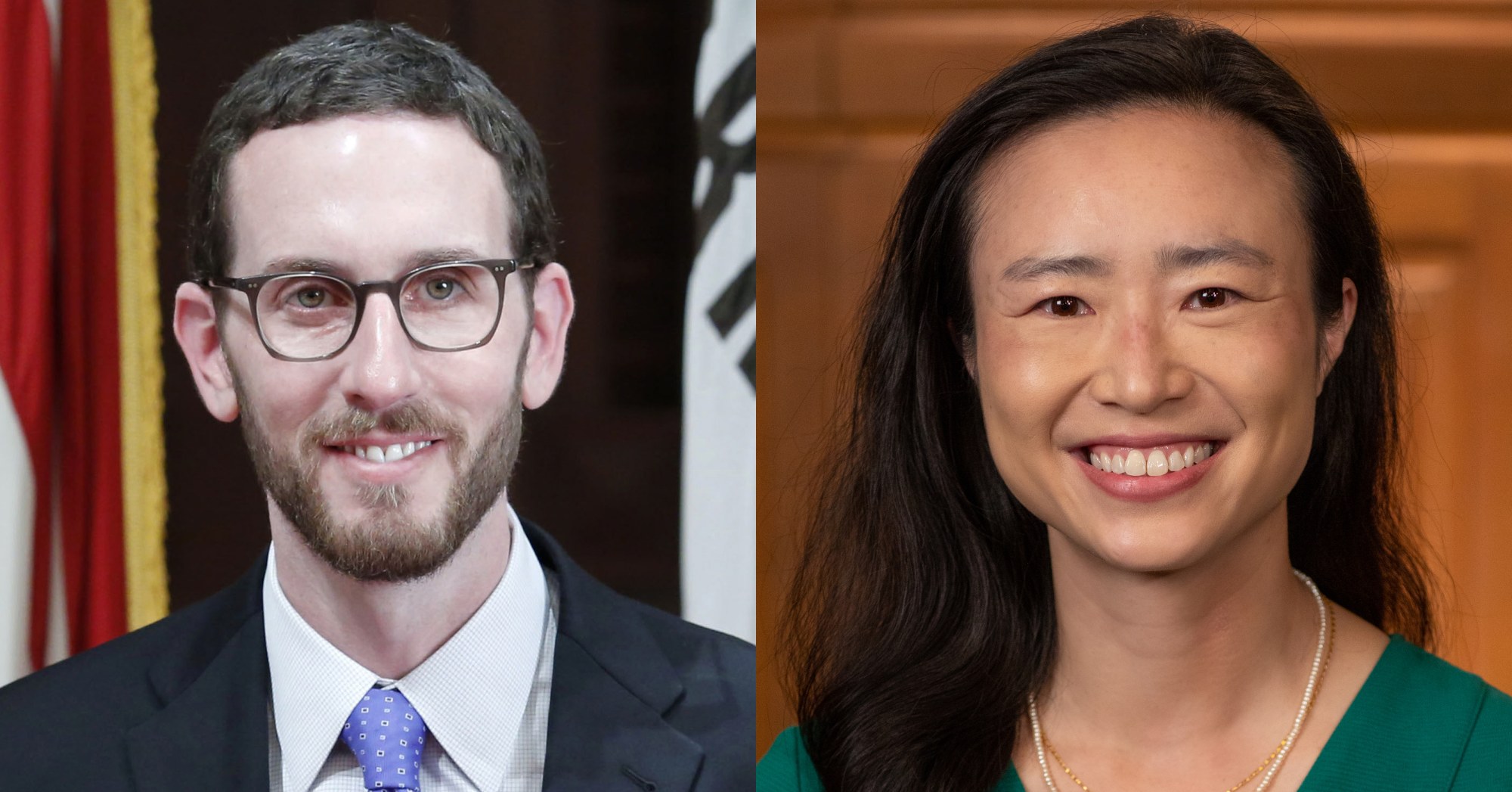
Top image: State Sen. Scott Wiener, left, and San Francisco Supervisor Connie Chan are competing for the 11th District seat Nancy Pelosi is giving up. Photos: California State Senate (Wiener, public domain) and San Francisco Board of Supervisors (Chan, public domain) via Wikimedia Commons (Wiener, Chan)
In most of the country, the Nov. 3 midterms are a contest between Republicans and Democrats. In four Bay Area congressional districts, voters will choose between two Democrats, and members of the region’s own congressional delegation are backing opposite sides.
California’s top-two primary sends the two leading June finishers to November regardless of party. This year it produced all-Democratic contests in the 4th, 11th, 12th and 14th districts, according to the Secretary of State’s certified candidate list. That means Republican and independent voters in those districts will be choosing between two Democrats, and in close races they could tip the outcome.
The races are being held under the new congressional map approved by voters as Proposition 50 last November. Supporters described it as a response to Republican redistricting in Texas; Republicans opposed it as a partisan gerrymander.
San Francisco: the race for Pelosi’s seat
The highest-profile contest is in the 11th District, where Rep. Nancy Pelosi is retiring after nearly four decades. State Sen. Scott Wiener faces Supervisor Connie Chan, whom Pelosi endorsed last spring.
A University of Southern California poll shared with the San Francisco Standard found Wiener at 47% and Chan at 41% among likely voters, with 9% undecided. The lead is within the poll’s margin of error of plus or minus 4.6 points. The survey of 454 likely voters was conducted by email in five languages from Oct. 16 to 19.
The poll found that voters who view Pelosi favorably are “splitting their votes,” with Wiener winning a slight majority of them. “Pelosi has endorsed the person who has far left support … so her endorsement is not translating to Chan support,” lead pollster Christian Grose told the Standard. “On the other hand, Chan might be losing by a lot without the endorsement.” Grose added, “I wouldn’t rule her out, but I would rather be Scott Wiener than Connie Chan based on these results.”
The Standard reported that Wiener runs strongest among self-identified Democrats and voters earning more than $100,000, and Chan runs strongest among independents, “very liberal” voters and Democratic Socialists of America supporters. Wiener has campaigned on the housing laws he has passed in Sacramento. Chan is aligned with labor unions and progressive activists who argue Wiener is too close to business interests.
East Bay: the delegation splits over the 14th District
The sharpest split inside the delegation is in the 14th District, which covers Fremont, Hayward and the Tri-Valley. Rep. Aisha Wahab, who previously served in the state Senate, won the seat in an August special election and was sworn in Sept. 2. She faces Melissa Hernandez, a health care services director, in November.
At an Oct. 7 candidate forum in Dublin, Wahab listed endorsements from Sens. Adam Schiff and Alex Padilla, Gov. Gavin Newsom, Sen. Bernie Sanders, the California Democratic Party and the California Police Chiefs Association, according to Pleasanton Weekly. Hernandez is backed by two of Wahab’s Bay Area House colleagues, Reps. Zoe Lofgren and Sam Liccardo, along with Dublin Mayor Sherry Hu, the Deputy Sheriffs’ Association of Alameda County and the Alameda County Firefighters Association.
The debate grew heated. Hernandez accused Wahab of “communications with the Taliban,” then clarified that she was referring to her own opposition to diplomatic relations with the Taliban, which she said Wahab had suggested in an Aug. 24 Democracy Now! interview. In that interview, the paper reported, Wahab said the U.S. should be “exercising diplomacy and having a relationship” with whoever is in power in Afghanistan to push toward human rights and women’s rights. Wahab called the remark a “racist dog whistle.” Wahab, for her part, said the pro-Israel group AIPAC had spent up to $7 million in the Aug. 18 special election and $2 million in the June primary to help Hernandez. Candidates do not control such independent spending, Wahab acknowledged. Hernandez replied, “Folks, do your research.”
The two also differ on policy. Wahab has campaigned on an economic bill of rights, anti-corruption measures and banning private equity firms from buying single-family homes, and she opposes moratoriums on data centers. Hernandez has emphasized cost of living, immigration reform, public safety and local control over data centers.
Oakland and the North Bay
In the 12th District, Rep. Lateefah Simon faces fellow Democrat Jamie Joyce, a nonprofit executive director. Simon took 84.2% of the June primary vote to Joyce’s 15.6%, according to Ballotpedia.
In the 4th District, Rep. Mike Thompson faces Democrat Eric Jones, who is listed on the ballot as a businessman and nonprofit executive.
Where Republicans are on the ballot
Elsewhere in the region, Republicans are on the November ballot against Democratic incumbents, according to the certified list: Robin Littau against Rep. Jared Huffman in the 2nd District, Rudy Recile against Rep. John Garamendi in the 8th, John McBride against Rep. Josh Harder in the 9th, Jeff Frese against Rep. Mark DeSaulnier in the 10th, Charles Hoelter against Rep. Kevin Mullin in the 15th, Peter Sundin Soulé against Liccardo in the 16th, Ritesh Tandon against Rep. Ro Khanna in the 17th, Shane Lewis against Lofgren in the 18th and Peter Coe Verbica against Rep. Jimmy Panetta in the 19th.
Neither of California’s U.S. Senate seats is on the ballot this year.


Leave a Reply