
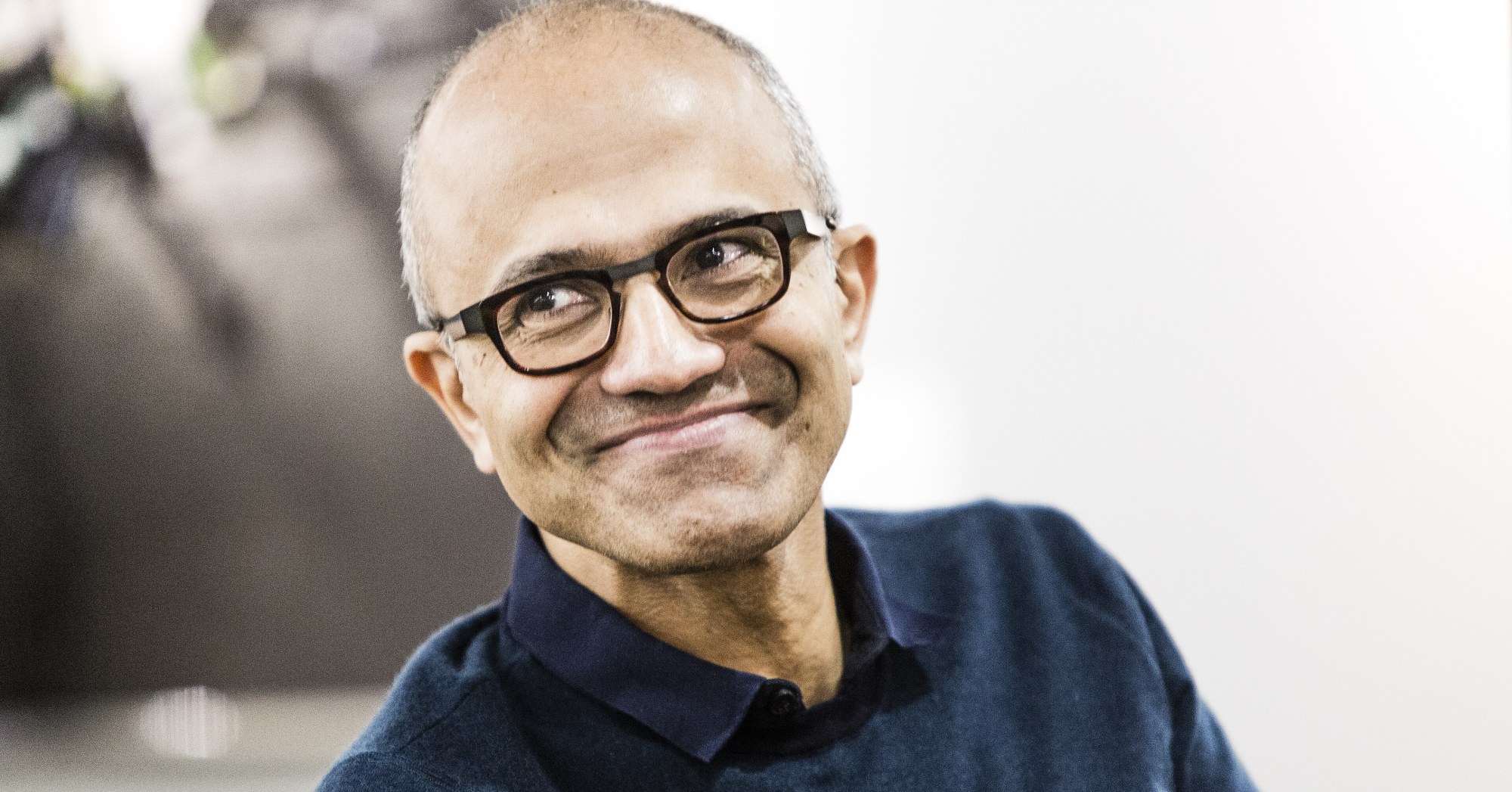
Top image: Microsoft Chairman and CEO Satya Nadella. Microsoft reports fiscal first-quarter results after the market closes Wednesday, Oct. 28. Photo: Brian Smale and Microsoft / CC BY-SA 4.0 via Wikimedia Commons
Over the next 10 days, the companies that anchor Silicon Valley’s economy and much of the stock market will show investors how much they are spending on artificial intelligence and how much of it is paying off.
Alphabet and Microsoft report Wednesday, Oct. 28. Amazon and Santa Clara-based Intel follow Thursday, Oct. 29. Cupertino-based Apple reports Monday, Nov. 2, the first earnings call under CEO John Ternus. AMD, also based in Santa Clara, reports Tuesday, Nov. 3, which is Election Day. Meta and Tesla reported on Oct. 21. Nvidia had not announced its date as of Saturday.
The schedule
All times are Pacific and come from each company’s investor-relations page.
- Alphabet: Wed., Oct. 28, call at 1:30 p.m. (Alphabet)
- Microsoft (fiscal first quarter): Wed., Oct. 28, after the market closes; webcast at 2:30 p.m. (Microsoft)
- Amazon: Thu., Oct. 29, call at 2 p.m. (Amazon)
- Intel: Thu., Oct. 29, after the market closes; call at 2 p.m. (Intel)
- Apple (fiscal fourth quarter): Mon., Nov. 2, call at 2 p.m. (Apple)
- AMD: Tue., Nov. 3, call at 2 p.m. (AMD)
- Nvidia: Date not yet announced. In an Oct. 20 preview, Charles Schwab listed Nov. 18. Nvidia’s own events page had not posted a date as of Saturday.
What analysts expect
Schwab published consensus estimates as of Oct. 20. They are averages of analyst forecasts and are subject to change.
- Alphabet: earnings of $3.02 a share, up 5.1%, on revenue of $128.1 billion, up 25.2%.
- Microsoft: $4.72 a share, up 14.4%, on revenue of $90.7 billion, up 16.7%.
- Amazon: $1.96 a share, up 0.6%, on revenue of $202.2 billion, up 12.3%.
- Apple: $1.98 a share, up 7.2%, on revenue of $113.2 billion, up 10.5%.
- Nvidia: $2.48 a share, up 90.5%, on revenue of $109.2 billion, up 91.5%.
Schwab’s table did not include Intel or AMD.
What Meta and Tesla already showed
Meta’s third-quarter release reported revenue of $64.60 billion, up 26% from a year earlier and above the $63.4 billion consensus Schwab cited. The quarter included a $9.89 billion charge tied to Meta’s August agreement with 52 state attorneys general to resolve litigation over teen mental health and social media. With the charge, operating margin fell to 20% from 40%. Diluted earnings were $3.83 a share; Meta said they would have been $7.40 without the charge. Net income rose 264% to $9.86 billion because the year-earlier quarter carried a large tax charge.
“Our investments are paying off, the core business is strong, and we’re seeing velocity across the board,” CEO Mark Zuckerberg said in the release.
The spending shows up in Meta’s cash flow. Capital expenditures, including principal payments on finance leases, were $34.91 billion in the quarter, and free cash flow was negative $2.12 billion. Meta narrowed its 2026 capital-spending outlook to $135 billion to $145 billion. It said it expects “to continue investing aggressively” and to see “strong overall revenue growth throughout 2027.” It also said it expects Reality Labs losses to narrow to around $15 billion next year as it shifts money toward AI. The company also warned of continued “scrutiny on youth-related issues,” with “a number of youth-related trials scheduled in the coming months in the U.S.”
Tesla’s quarterly update showed revenue of $28.05 billion, roughly flat from $28.10 billion a year earlier. Adjusted earnings were 48 cents a share and GAAP earnings were 22 cents. CNBC reported that both topped analysts’ expectations. Capital expenditures were $4.73 billion and free cash flow was $1.53 billion. Revenue from energy generation and storage fell to $2.88 billion from $3.42 billion a year earlier. Tesla’s plans for a possible combination with SpaceX are covered here.
Spending, debt and commitments
Schwab framed the season around rising AI spending and its strain on free cash flow. It cited estimates from Goldman Sachs and Morgan Stanley that the seven largest tech companies’ capital spending could approach $1.1 trillion in 2027 alone. It also cited a September paper by Columbia Business School professor Stijn Van Nieuwerburgh, who estimated that AI-related data centers, power systems, networking and other infrastructure could require $10.3 trillion of investment from 2025 through 2032.
Schwab also pointed to commitments that sit outside the headline spending numbers. Citing data from investment banks, it said the Financial Times estimated that Alphabet, Microsoft, Amazon, Meta, Oracle and Nvidia had about $1.5 trillion in purchase commitments at the end of June, up from about $1 trillion three months earlier. Schwab said Goldman Sachs separately counted about $1.5 trillion in lease commitments, roughly $1 trillion of which had not yet begun. Meta’s long-term debt rose 190% from a year earlier, to $83.66 billion, in the second quarter.
“Higher interest costs are certainly an important factor in profitability,” Nathan Peterson, director of derivatives research and strategy at the Schwab Center for Financial Research, told Schwab. “I’m not sure if this will be a problem for this upcoming quarter per se, but given the heavy—and projected—issuance of debt by hyperscalers, interest expense could become important down the line.”
Not everyone is pessimistic. Peterson also said that if the large cloud companies “can surprise on AI monetization or show accelerated AI adoption for their products, it could help quell investor fears around spending.” Schwab quoted Deepwater Asset Management’s Gene Munster, who argued in a CNBC interview that “the climate still looks really good for the AI trade.” On the other side, Schwab noted a Gartner forecast that 80% of “neocloud” providers, companies that rent out computing capacity, will cease independent operations by 2030.
What to watch, company by company
Alphabet. According to Schwab, Google Cloud revenue rose 82% in the second quarter to a record $24.8 billion. CNBC reported that the growth rate was up from 63% in the first quarter. Watch whether that pace held, along with spending plans and early demand after this week’s agreement to offer OpenAI’s models on Google Cloud.
Microsoft. Schwab said Microsoft 365 Copilot had 30 million paid seats last quarter, up 50% from the prior quarter, and that it faces competition from Claude Enterprise, ChatGPT Enterprise and Gemini Enterprise. It said Microsoft Cloud revenue rose 26% last quarter while gross margins dipped slightly. Analysts will also be watching usage-based pricing for Copilot Cowork and GitHub Copilot.
Amazon. Schwab said Amazon Web Services grew 37% in the second quarter, its fastest pace in 18 quarters. Watch AWS growth, capital spending and how Amazon describes its arrangement to host OpenAI models.
Apple. Schwab said iPhone sales rose 22% last quarter and pointed to early usage of Siri AI, which launched in beta in September. It also noted reports of lukewarm demand for the iPhone 18 Pro models and reports that Apple raised orders for the foldable iPhone Duo. The Nov. 2 call is the first since Ternus succeeded Tim Cook as CEO on Sept. 1.
Intel and AMD. Both report in the same stretch. Their updates on data-center chips and manufacturing will be read alongside the spending plans of the cloud companies that buy their products.
Nvidia. The chipmaker reports last. Schwab’s consensus calls for revenue to nearly double from a year earlier.
All figures come from company filings and releases or from the analyst estimates cited above. Estimates change often; check the linked sources for the latest numbers.




Leave a Reply