
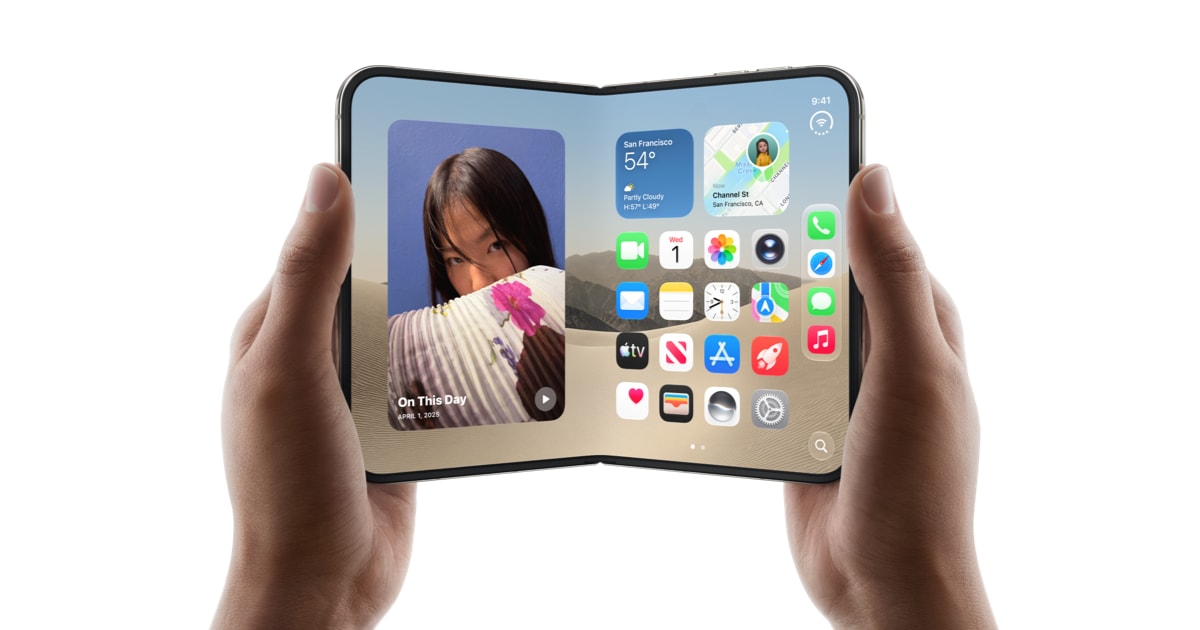
Top image: Apple’s iPhone Duo, the company’s first foldable iPhone, shown open in an Apple handout image. Image: Apple (handout)
Apple’s first foldable iPhone reached store shelves on Friday, and for part of the trading day Apple was again the most valuable company in the world. Shares hit an intraday record above $351, briefly putting Apple’s market value at roughly $5.12 trillion and ahead of Nvidia, 9to5Mac reported. By mid-afternoon the order had flipped back: CNBC put Apple at $5.05 trillion and Nvidia at $5.10 trillion.
The ranking will keep moving. It is worth separating what Apple has said about the iPhone Duo from what investors are inferring about it.
What Apple claims
Apple’s Sept. 9 announcement describes the iPhone Duo as its first foldable iPhone, with a 7.6-inch inner display and a 5.4-inch outer display. The company’s specifications include:
- the A20 Pro chip, built on a 2-nanometer process, which Apple says delivers up to 35% better sustained performance than iPhone 17 Pro;
- a Grade 5 titanium frame and a hinge Apple says contains more than 100 components;
- dual batteries, Touch ID and eSIM-only connectivity; and
- storage from 256GB to 2TB, with prices starting at $1,999.
“iPhone Duo is the most transformational change to iPhone since the original,” said John Ternus, Apple’s CEO, in the release.
Two definitions help. “Sustained performance” refers to how fast a chip runs under prolonged load, after heat forces it to slow down, not its peak burst speed. A “2-nanometer process” is a manufacturing generation label; it signals denser, more efficient transistors but is not a literal measurement of any feature on the chip. Both claims are Apple’s own and have not yet been tested independently at scale.
Preorders opened Oct. 16. The phone went on sale Oct. 23 in more than 70 countries, with 28 more to follow Oct. 30. Apple’s launch-day release showed Ternus and Deirdre O’Brien greeting customers at the Domain Northside store in Austin, Texas, while Greg Joswiak and Vanessa Trigub did the same at Apple Fifth Avenue in New York. Apple also offers the phone through its Apple Upgrade program, financed through Klarna, from $57.99 a month.
What investors are inferring
The bullish case is laid out in a CNBC opinion piece by Jeff Kilburg of KKM Financial, a CNBC Pro contributor whose firm’s ETF holds Apple. Kilburg wrote that preorders sold out almost immediately, with some delivery dates pushed into January, and that Apple has reportedly raised production targets. He noted that the top configuration costs more than $3,000. Apple shares were up 4% in October as of Friday, he wrote, while Nvidia was down 7%.
Those points come from an investor with a stated position. Sold-out preorders show that demand exceeded initial supply, but they do not tell you how large either number is. Apple has not published unit sales.
Why Nov. 2 matters more
Apple reports fiscal fourth-quarter results on Nov. 2. Kilburg wrote that analysts expect about $113 billion in revenue, and that Apple had guided to growth of 9% to 11%. The Duo went on sale after that quarter closed, so its first real contribution will show up in the December quarter. What investors will listen for on Nov. 2 is guidance.
Kilburg also pointed to services. By his figures, Apple’s services business generated about $109 billion in fiscal 2025 at a gross margin of roughly 75%, compared with about 37% for hardware, and accounted for more than 40% of gross profit. That is the argument behind a $5 trillion valuation: every new iPhone owner is also a long-term services customer.
The Silicon Valley angle
The contest at the top of the market is a contest between two Santa Clara County companies with different businesses. Nvidia, headquartered in Santa Clara, is valued on demand for the chips that train and run artificial intelligence. Apple, in Cupertino, is valued on the number of people who carry its devices and pay for its services. The iPhone Duo is Apple’s bet that a new form factor can renew the upgrade cycle in a mature smartphone market. Nvidia’s value rests on how long the AI data-center boom lasts.
The long view
Market-cap rankings swap places on ordinary news, and Friday’s intraday crossing will not mean much by itself a year from now. The more durable question is whether foldables become a mainstream product category or stay a niche one. Samsung and others have sold foldable phones for years without making them the default. Apple has a record of entering categories late, at a high price, and resetting expectations. The early demand signals are strong, but the evidence that matters, sustained sales after launch-week enthusiasm fades, will not arrive until well into 2027.






Leave a Reply