
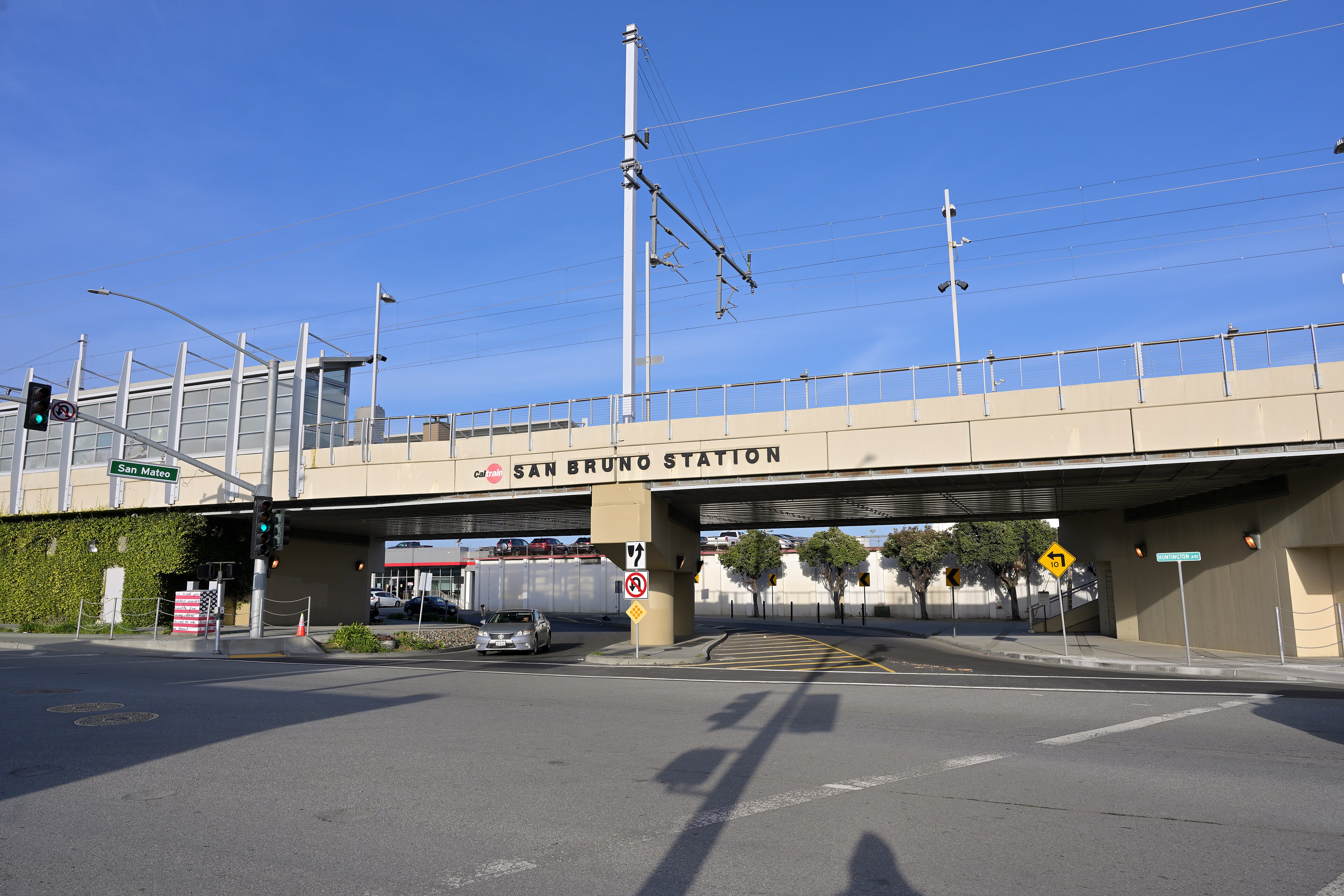
Top image: The San Bruno Caltrain station bridge over San Bruno Avenue, near the corner where two 10-story apartment buildings are under construction. Photo: 4300streetcar / CC BY 4.0 via Wikimedia Commons
On the corner of San Bruno Avenue and El Camino Real, the tallest buildings San Bruno has seen in decades are rising, and no San Bruno voter was asked about them. That fact sits at the center of Measure S, a city-sponsored proposal on the Nov. 3 ballot to repeal Ordinance 1284, the 1977 voter initiative that requires a citywide election before the City Council can approve a building over three stories or 50 feet.
The measure needs a simple majority. A yes vote repeals the ordinance in full. A no vote keeps it.
What Ordinance 1284 does today
According to the city’s Measure S FAQ and the impartial analysis prepared by City Attorney Trisha Ortiz, the ordinance, codified at Chapter 12.26 of the municipal code, requires voter approval before the city can authorize:
- buildings or structures taller than three stories or 50 feet;
- residential density beyond what zoning allowed on Oct. 10, 1974;
- free-standing multistory parking structures; and
- development that affects Crystal Springs Road between Oak Avenue and the Junipero Serra Freeway, or Sneath Lane from El Camino Real to the western city limits.
Because voters adopted it, only voters can repeal it. A 2014 exemption already allows four- to seven-story buildings in a 155-acre transit corridor along El Camino Real, San Bruno Avenue and San Mateo Avenue, the San Mateo Daily Journal reported.
The city’s case: state law got there first
The city’s argument rests on the gap between what the ordinance was meant to do and what it can still do. The July 28 staff report from City Manager Alex D. McIntyre, prepared by Assistant City Manager Joseph D. Toney, lists the state laws that now override local height and density limits: accessory dwelling unit rules, SB 9’s lot splits, the State Density Bonus Law and SB 79, the 2025 law setting minimum heights and densities within a half mile of Caltrain and BART stations.
Two projects show the effect. The city’s FAQ says a six-story building at 732 El Camino Real was completed in 2025, and two 10-story buildings at 850 San Bruno Avenue are under construction with completion expected in 2027. Each exceeds voter-approved limits, the city says, and it “was obligated to approve them to avoid risk of fines and court judgments.” No election was held.
The staff report also flags an irony in SB 79: state law lets cities adopt alternative plans to soften the transit upzoning, but in San Bruno, adopting one would itself trigger a vote under Ordinance 1284.
Councilmember Tom Hamilton made the fiscal argument directly to the Daily Journal’s Holly Rusch. Pointing to the 10-story project, he said: “I want to be clear: we welcome that building. We welcome those families to San Bruno, but that building is not going to pay any property taxes. So that is 341 new families in San Bruno who we will need to provide police, fire, streets, parks, all those services, and the property that they live in doesn’t contribute to it.” The city’s FAQ makes the same point: 100% affordable projects are exempt from property tax, while the ordinance “effectively only limits revenue-generating development such as hotels and office buildings.”
The projects that got away
The staff report cites two examples:
- The Crossings hotel (1999). A measure to allow a 10-story hotel at the former Navy site won only 46% of the vote. A seven-story version later passed, but the deal fell through. The city puts the forgone hotel revenue at $3 million to $4 million a year in today’s terms.
- Bayhill Business Park. Google has told the city it does not currently intend to carry out its master plan for the Bayhill campus, home to YouTube, “due, in part,” to the ordinance’s height and parking-structure limits, according to the staff report.
The case for keeping it
Ordinance 1284 was adopted during a period of concern about rapid growth across the Bay Area, and its stated purpose was to give residents “direct decision-making authority over the most consequential land use changes affecting the character of their community,” the staff report says. Repeal would move those decisions from the ballot box to the City Council. Projects would still get staff and CEQA review, a Planning Commission hearing and two council hearings, the city says, but not a public vote.
The city’s own polling suggests a close electorate. A November 2025 survey commissioned by the city found 53.2% support for full repeal and 51.4% for a narrower version that would have applied only to the main corridors while keeping voter approval in single-family neighborhoods. In June the council chose full repeal, the option that polled best.
The ballot argument in favor was filed by the City Council, according to the Daily Journal. Measure S shares the ballot with Measure DD, on fireworks, and Measure EE, a business license tax, according to the city’s ballot measures page.
What happens next
If Measure S passes, the next fight moves to City Hall. The council launched its Elevate San Bruno initiative in January to rewrite the General Plan, specific plans and design standards to attract private investment. The staff report says carrying out that plan under the current ordinance would require a ballot measure in 2028 or later.
The long view
San Bruno is a clear case of what happens when a 1970s local veto collides with today’s state housing mandates. The ordinance no longer stops tall apartment buildings. By the city’s account, it mainly stops the commercial buildings that pay for city services. Whether residents see that as a reason to repeal it, or as the last lever they have left, is the real question on the ballot.



Leave a Reply