
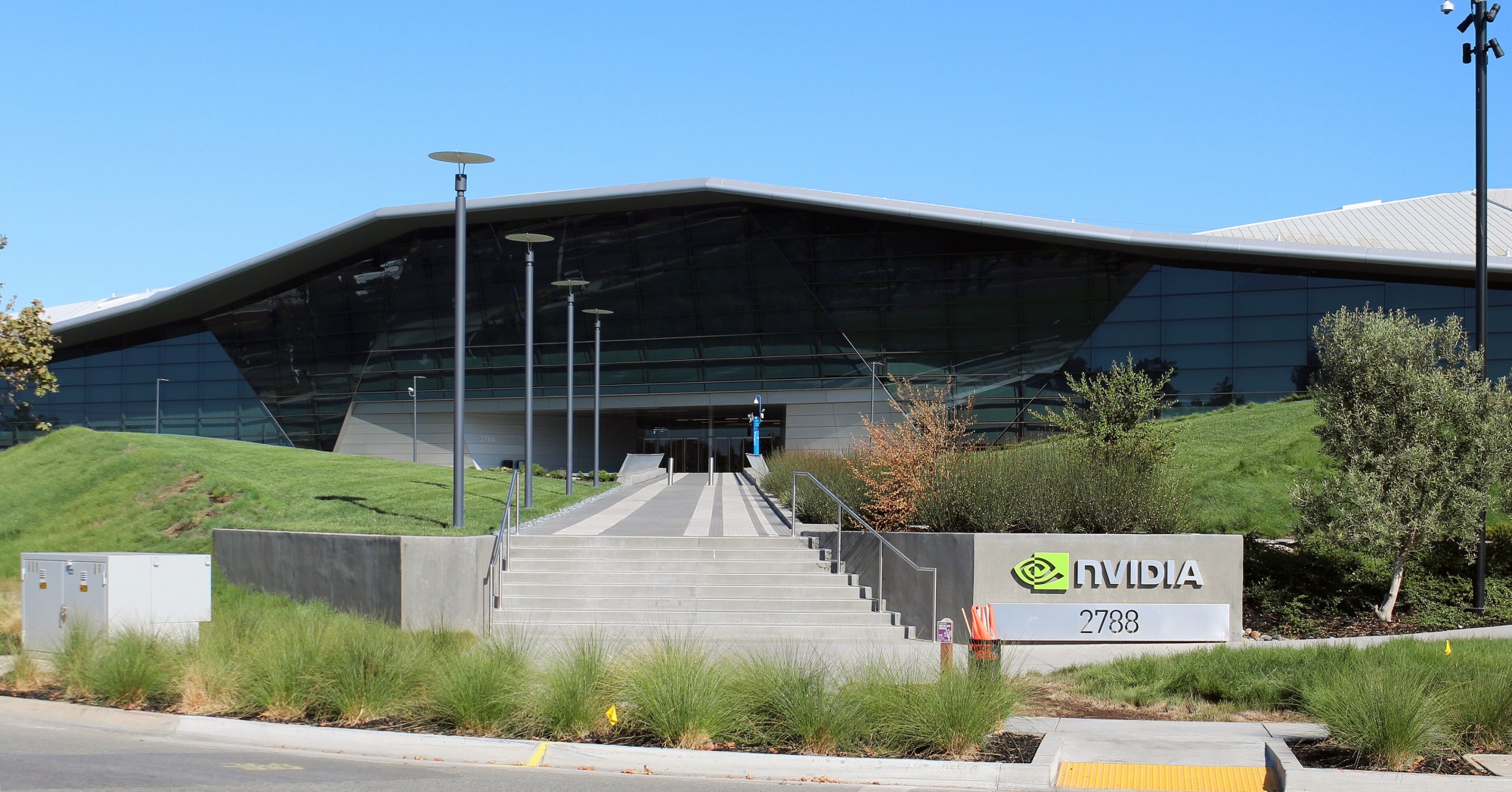
Top image: Nvidia’s Endeavor headquarters building in Santa Clara. Photo: Coolcaesar / CC BY-SA 4.0 via Wikimedia Commons
For most of the AI boom, Nvidia’s balance sheet was a story about cash coming in. This month it became a story about promises going out.
The Santa Clara chipmaker has become one of the most important financiers of the AI infrastructure build-out, and an Oct. 24 CNBC analysis by Kif Leswing and Isabel O’Brien argues that role now faces its first serious test, as the “neocloud” companies Nvidia has helped underwrite take a beating in the market.
The size of the commitments
According to CNBC, as of its July quarter Nvidia had $36 billion in off-balance-sheet AI cloud agreements, or backstops, for neocloud operators. For the vast majority of these deals, CNBC noted, Nvidia does not have to pay unless a participant defaults. Separately, it has agreed to guarantee up to $105 billion tied to OpenAI’s planned 10-gigawatt data center in Pike County, Ohio, where SB Energy is the landlord, along with a $20 billion tenant lease commitment. For CoreWeave alone, CNBC reported, Nvidia has committed to buy up to $6.3 billion of compute if the company cannot find another taker. The Ohio guarantee ends if OpenAI posts its own collateral or reaches a high enough credit rating.
Nvidia’s own filings show how quickly its obligations have grown. Its most recent quarterly report to the SEC shows supply-related commitments rising from $119 billion to $279 billion, plus about $3.5 billion in guarantees tied to land and power. CNBC reported that the August filing outlined more than $500 billion in off-balance-sheet commitments over the coming years, most maturing through fiscal 2029.
The company’s stated rationale is demand. “We believe these AI cloud partners have strong customer demand and robust sales pipelines but are constrained by the large-scale infrastructure that is required to meet that demand,” Nvidia said in its quarterly filing, as quoted by CNBC.
The market wobble
The test is coming from the companies on the other side of those agreements. CNBC reported that CoreWeave, Nebius and IREN have each fallen at least 30% this month. CoreWeave, which carries roughly $51.6 billion in debt, has seen its credit-default-swap spreads move above 11%, and yields on its 2031 and 2032 bonds have climbed above 15%, levels that signal investors see meaningful risk.
Nvidia’s own shares were down 7.6% in October through Friday, according to CNBC, a more modest move that reflects a company with a very different financial profile. CNBC put Nvidia’s equity portfolio at $99 billion as of the second quarter and its free cash flow at $70 billion in the first half of the year, against just over $4 billion for AMD.
The two sides of the argument
Nvidia CEO Jensen Huang has framed the financing as a bridge rather than a bet. Speaking to CNBC in Berlin on Thursday, he called demand for neoclouds “off the charts.” “What is missing in the middle is the working capital to fuel that growth,” he said. “Because there’s just so much demand across so many sectors of AI, there’s a scarcity of capital.” Huang also said this week that CoreWeave does not need Nvidia’s backstop and that its cost of capital is falling.
Skeptics see risk concentrated in one direction. “If the demand for compute doesn’t meet these really super lofty expectations, we’re going to have a problem,” David Trainer, founder and CEO of New Constructs, told CNBC.
The credit-rating view is more measured. David Gonzales, a vice president at Moody’s, told CNBC that the agency does not count guarantees as debt when rating corporate buyers but is “constantly monitoring” them. He said chips are likely to retain “values in excess of contractual residual value amounts” in the near future, which would mitigate risk in many of Nvidia’s structures, while adding that how much exposure investment-grade AI players can handle is “the question we’re evaluating at all times every day.” Nvidia declined to comment to CNBC.
Both things can be true at once. Nvidia has the cash flow to absorb losses that would be existential for a smaller company, and its partners’ customers include the best-capitalized firms in technology. But the backstops tie Nvidia’s results more closely to the health of a group of fast-growing, heavily leveraged operators than its income statement alone suggests.
Why it matters in the valley
Nvidia, with a market value CNBC put at about $5 trillion, is headquartered in Santa Clara. Its financing decisions shape not only its own earnings but the pace of the data center build-out that South Bay and Peninsula governments are now trying to regulate, as the Chronicle has reported from San José to San Mateo County.
Investors will get the next detailed look when Nvidia files its next quarterly report. The disclosures to watch are the backstop totals, any drawdowns on capacity guarantees, and whether the OpenAI Ohio commitment has changed shape.
The long view
Every major technology cycle has had a moment when the supplier became the lender. Nvidia’s version is unusually large and unusually visible, and it reflects real confidence in demand that, so far, customers have borne out. The company is using its balance sheet to keep the build-out moving at a time when traditional credit markets are charging smaller operators double-digit yields. If demand holds, the backstops will look like a shrewd use of cash that locked in a generation of customers. If it softens, they will be the place where the AI boom’s financing risk shows up in Santa Clara. Either way, Nvidia’s next filings are now as much about credit as about chips.





Leave a Reply