
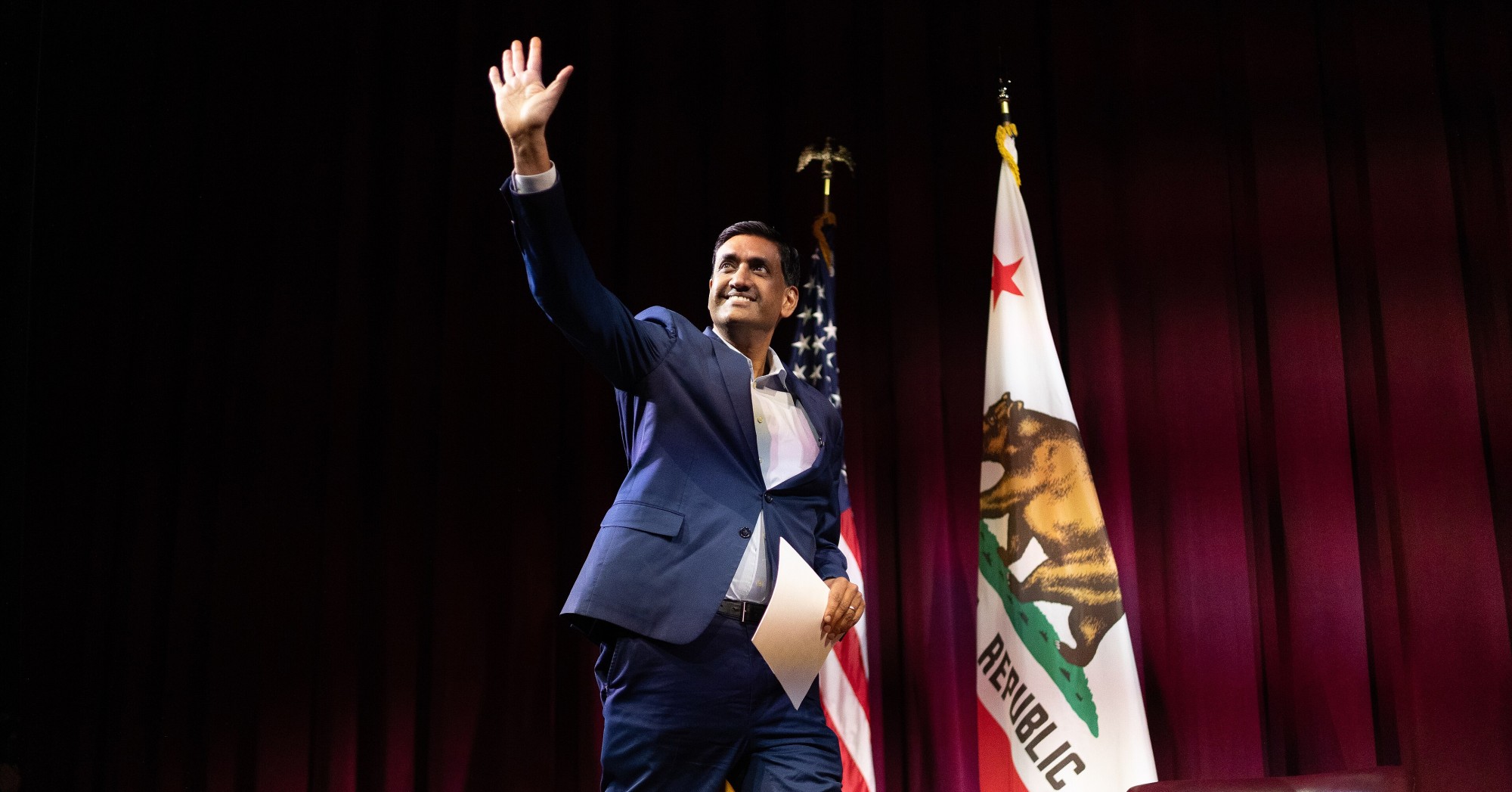
Top image: Rep. Ro Khanna speaking at Stanford University in February 2026. Photo: Anderseidesvik / CC BY-SA 4.0 via Wikimedia Commons
Rep. Ro Khanna spent the past week doing something few members of Congress attempt in the final stretch before a midterm: taking his own economic vision on the road to the voters most skeptical of politics as usual. The Fremont Democrat, who represents the heart of Silicon Valley and is widely viewed as a likely contender for the 2028 Democratic presidential nomination, carried his “Students for Solidarity” town hall tour from Boston to Orlando to Berkeley to Reno.
A four-stop college tour
The Washington Post, which followed Khanna to the University of Central Florida, described the trip as a “four-stop college tour” aimed at energizing young voters. In Orlando, he campaigned alongside Angie Nixon, Florida’s progressive Democratic Senate candidate. The Post reported that his remarks “drew repeated rounds of applause,” and that when Trump voters in the crowd tried to talk over him during the question-and-answer session, “some attendees jumped to his defense.” All of the students the Post interviewed afterward said they would consider supporting him for president.
At home in the Bay Area, the tour stopped Wednesday on UC Berkeley’s Sproul Plaza. The Daily Californian reported that nearly 200 people turned out to hear Khanna alongside San Francisco Supervisor Connie Chan, Saikat Chakrabarti and other progressive leaders. Former U.S. Labor Secretary Robert Reich, a UC Berkeley professor emeritus, introduced him.
“Few people have the chance to bend history,” Khanna told the crowd. “This is the time when we can build a totally different politics, a totally different Democratic Party guided by morality, guided by ambition.”
He closed the night by taking audience questions on artificial intelligence and on the possibility of a 2028 campaign, and he laid out a platform in a sentence: “We need a new vision in this country that is going to stand for taxing billionaires, Medicare for all, for free childcare. For a vision that says no new foreign wars and no bloated Pentagon budget.”
On Thursday the tour reached the University of Nevada, Reno, where KOLO-TV reported Khanna was joined by journalist Don Lemon. The tour’s slogans, according to KOLO, include “An education, not a debt sentence,” “Jobs for us, not AI” and “Medicare for all of us.”
“We want to encourage young people to get out and vote, but we also want to speak to the issues they care about,” Khanna told the station, citing free college, ending the war in Iran “that’s driving up prices,” and the cost of living. KOLO noted that Khanna helped drive the Google-supported TechWise program at UNR, which funds students pursuing software engineering careers, a concrete example of the tech-to-everywhere agenda he talks about on the stump.
The progressive capitalist pitch
What sets Khanna apart in a crowded field of potential 2028 Democrats is the economic argument underneath the rallies. The Post described him as a self-proclaimed “progressive capitalist” who shares progressive goals such as taxing the wealthy and strengthening unions while offering a vision in which government helps expand technology and manufacturing into communities that missed the tech boom.
His proposals, as the Post laid them out, include incentives for major technology companies to establish hubs and create jobs in rural and underserved areas, paired with penalties for companies that move jobs overseas and requirements that employers pay a living wage and stay neutral in union organizing. On manufacturing, he has pointed to cleaner technologies such as hydrogen-based steel as a way to rebuild industrial jobs while setting higher emissions standards than competitors like China.
“If Donald Trump can bully you to build his ballrooms, the next president should make these business leaders invest in America, in the Black South, in abandoned factory towns, in rural America,” Khanna told the Post.
He has also built a record of working across party lines. The Post highlighted his partnership with Rep. Thomas Massie, R-Ky., to force the release of the Epstein files, and one UCF student told the paper he loved that Khanna “does cross the aisle in a lot of situations to create some sort of bridge.”
The decision ahead
Khanna told the Post he plans to decide by the end of the year whether to seek the Democratic nomination, though he may not announce until later, and that the choice depends heavily on his family’s support. “They’re looking for someone who has a clear understanding of the modern economy,” he said of voters.
The audience he is courting is a demanding one. A September NBC News poll cited by the Post found that 47% of registered voters ages 18 to 29 had a negative view of capitalism, which makes Khanna’s effort to win them over with a pro-growth, pro-worker message all the more distinctive.
The long view
Silicon Valley has produced founders, chief executives and cabinet secretaries, but rarely a presidential contender who speaks the language of both the startup economy and the labor movement. Khanna’s tour is an early test of whether that combination can travel, from a crowd on Sproul Plaza to students in Orlando and Reno. If he runs, the 17th District’s congressman would bring the Bay Area’s argument about technology and opportunity to the center of the national Democratic debate, and this week’s campus stops show how he intends to make it.


Leave a Reply