
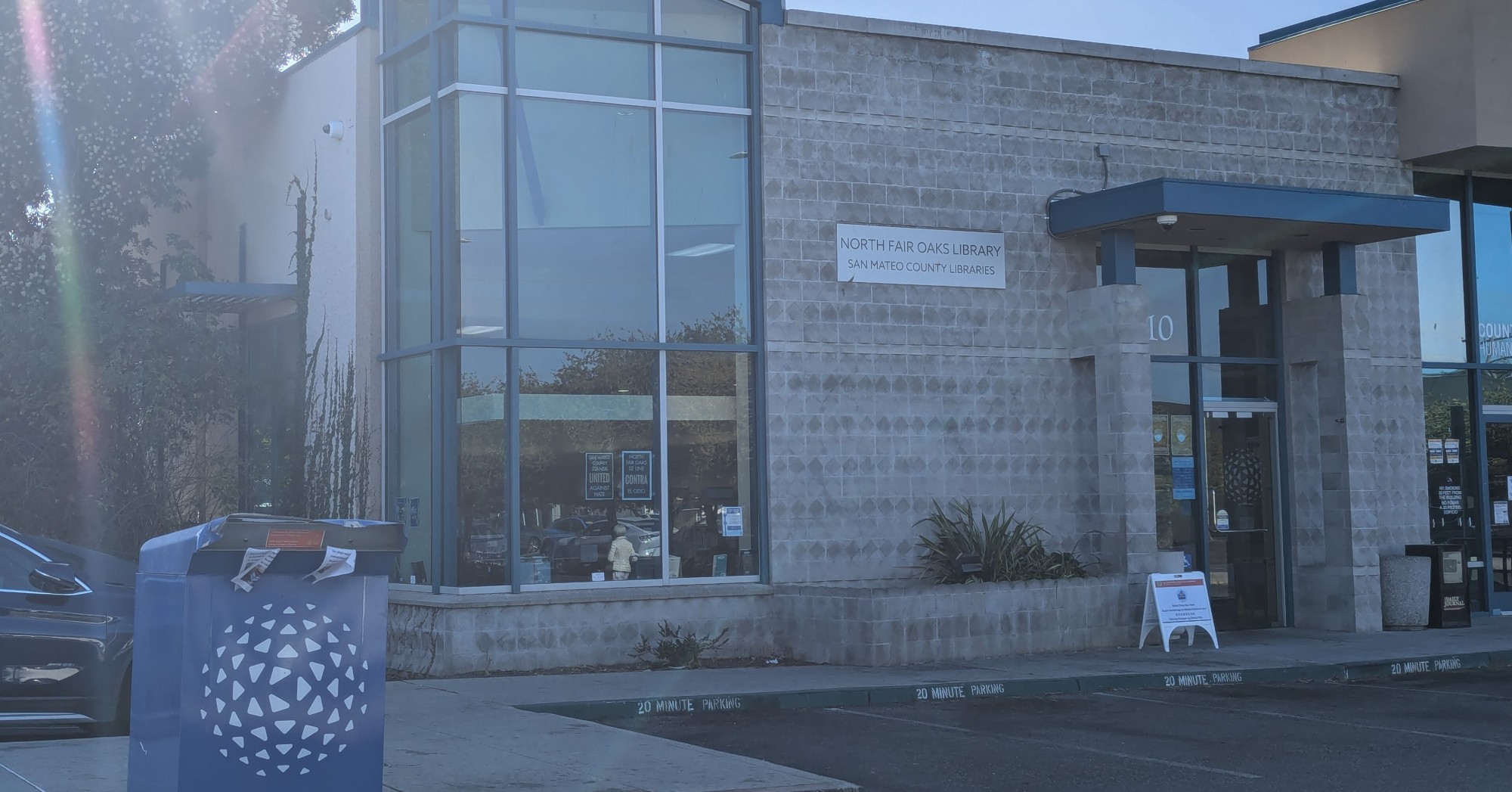
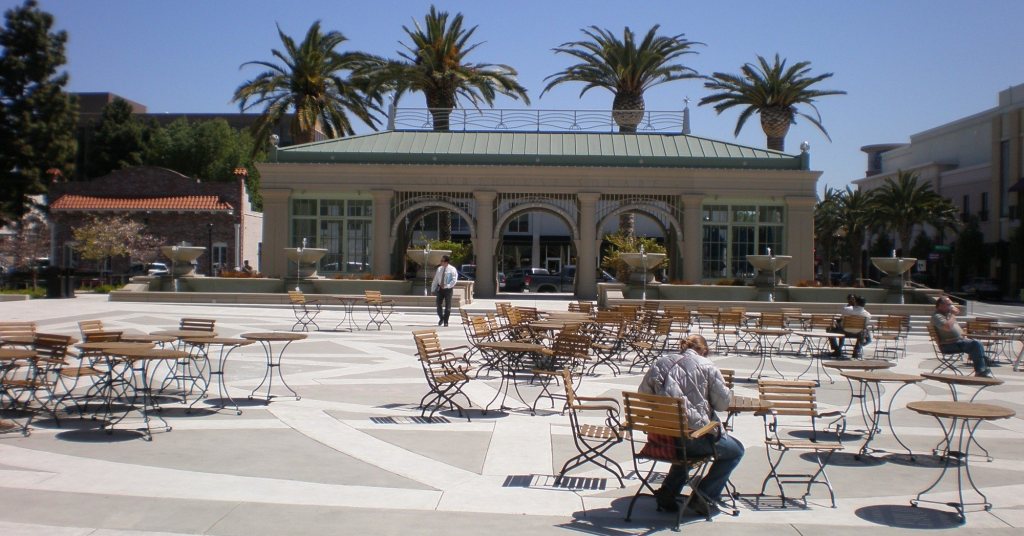
Top image: The North Fair Oaks Library in unincorporated San Mateo County. Photo: BriefEdits / CC BY-SA 4.0 via Wikimedia Commons
The San Mateo County Board of Supervisors took its first formal step toward regulating data centers on Oct. 20, and in doing so it stepped back from the most sweeping option on the table. The resolution supervisors passed directs county staff to study zoning changes for new data centers in unincorporated areas. The version on the agenda would have included consideration of a countywide ban. The version that passed did not.
That decision shifts attention from a headline-sized ban to a quieter question about the existing code. A Chronicle review of the county’s zoning regulations found that in North Fair Oaks, the unincorporated neighborhood wedged between Redwood City, Atherton and Menlo Park, “Server Farms” already appear on the list of permitted uses in two industrial districts, with the required planning permit listed as “None.”
What the board actually did
The resolution, file 26-853, was sponsored by Supervisor Lisa Gauthier, whose District 4 includes North Fair Oaks, and Board President Noelia Corzo. As introduced, it directed the Planning and Building Department to work with the County Executive’s Office and the County Attorney’s Office to “consider and prepare appropriate amendments to the County’s Zoning Regulations, including a potential Countywide ban, on new data center construction within the unincorporated area of San Mateo County.”
The staff report grounded the proposal in state law and local authority. It noted that California has recently enacted laws requiring data center projects to disclose and report water usage (AB 2619 and AB 2469) and ensuring that new data centers are subject to environmental review (SB 887), and it said the county “has the power to regulate, restrict, and/or prohibit data centers within the unincorporated area.”
At the meeting, the board changed course on the ban. According to The Mercury News, as summarized in a regulatory digest by Strisker, the resolution passed with majority approval but was narrowed to drop consideration of a countywide ban, with supervisors saying a ban would be too strict without more information on data centers’ impact. Corzo and Supervisor David Canepa were absent for the vote, the Mercury reported. The Legistar record lists a redlined version “from mtg amending language” among the attachments; the Chronicle was unable to retrieve that document from the county’s server, so the precise amended text could not be independently reviewed.
“What we are contemplating is taking an initial step to assess what is best for our communities, our residents, and our local economy,” Gauthier said, Bay City News reported. She pointed to the diesel backup generators that data centers often rely on and the emissions that come with them, according to the Mercury account.
The resolution does not stop any project by itself. Any ban or new restriction would need its own ordinance and Planning Commission hearings later, as Houseberry noted.
The fairgrounds pitch
The immediate spark was a proposal the county never accepted. In July, a company called Global Stack LLC pitched small “edge” data centers at eight Bay Area fairgrounds, including the San Mateo County Event Center, each drawing up to 10 megawatts, according to an analysis by the real estate site Houseberry citing SFist. County Executive Mike Callagy said the county had no interest in a data center at the Event Center, Houseberry reported, citing Hoodline, and the idea faded. Gauthier noted at the meeting that the Event Center had been solicited as a potential site, the Mercury reported.
There is a geographic wrinkle. The Event Center sits inside San Mateo city limits, Houseberry noted, so a zoning rule written for unincorporated land would not reach it. What stopped the pitch was the county acting as the landowner, not as a zoning authority.
Where the code is already open
Unincorporated San Mateo County is a patchwork, from the Coastside towns of Montara and El Granada to Ladera, Emerald Hills and Broadmoor. Houseberry, citing 2020 census data, put its population at 63,164, about 8% of the county. Most of that land has no industrial zoning that would invite a large computing facility.
North Fair Oaks is different. The county wrote two industrial mixed-use districts specifically for the neighborhood. The M-1/NFO chapter of the zoning regulations says its purpose is to provide industrial areas for manufacturing uses “that do not create more than a moderate impact on the surrounding area,” while accommodating a “compatible mix” of other uses and “mixed-use development that will create a vibrant, livable environment for area residents.” The M-1/Edison/NFO chapter covers the strip along Edison Way and the rail line.
Both chapters define a server farm as “a collection of computers or servers, usually maintained to store data or supply server functionality beyond the capability of a single machine.” And both list “Server Farms” as item six under light manufacturing and storage, with “None” in the column for the required planning permit. The M-1/NFO parking table sets a requirement of one space per 2,000 square feet of server farm.
That is not the same as no review at all. Both chapters state that new development not requiring a conditional use permit requires a site development permit, a design and site layout review under Section 6566 of the code. But both also state that “changes of use do not require a Site Development Permit.” In practical terms, a new building would go through design review, while converting an existing industrial building to computing use would not trigger a use permit hearing, the venue in which neighbors typically raise concerns about noise, generators and truck traffic.
Houseberry’s analysis reached a similar conclusion about the use permit and argued that removing “Server Farms” from the no-permit list “does most of the real work a countywide ban would do.” The firm also cautioned that a rule written too broadly could sweep in a lab’s server room, a telecom switch building or a hospital’s backup computing, and suggested defining data centers by power draw or floor area.
The North Fair Oaks definitions predate the AI build-out. A server farm “beyond the capability of a single machine” describes anything from a dot-com era back room to a multi-megawatt hall, which is why the definitional question may matter as much as the permit question.
The regional pattern
San Mateo County’s narrower approach contrasts with neighbors that have imposed outright pauses. In San Francisco, Mayor Daniel Lurie on Oct. 16 signed a 45-day moratorium authored by Supervisor Shamann Walton, which the Board of Supervisors approved unanimously, the San Francisco Standard reported. The Planning Department is studying impacts and developing controls; Walton has criticized the city’s zoning code for lacking a true definition of a data center. Brisbane, on the county’s northern edge, adopted its own pause on Oct. 1, according to Houseberry. Oakland and Gilroy have also passed temporary moratoriums, the Bay Area Brief reported, citing KALW.
Supervisors who favored a slower route have a case. A study-first approach lets the county write rules tailored to its actual land, rather than a blanket prohibition that could catch ordinary computing uses. It also preserves room for the employers, laboratories and hospitals that need server capacity. State law also offers a faster tool if the board later decides it needs one: Government Code 65858 permits a 45-day interim ordinance by four-fifths vote, which can be extended, as Houseberry noted.
What to watch
The study now moves to county planners and lawyers, with no deadline set in the public record reviewed by the Chronicle. Key questions for the draft:
- Whether “Server Farms” remain a no-use-permit use in the two North Fair Oaks districts, or move to a use permit or prohibition.
- How the county defines a data center, whether by power draw, floor area or function, so that rules distinguish a large facility from an accessory server room.
- Whether changes of use to computing facilities in existing industrial buildings will trigger review.
- How any rule addresses diesel backup generators, the emissions issue Gauthier raised.
- Whether the board revisits a broader prohibition once staff returns with impact data.
The long view
The data center debate in the Bay Area has largely been framed as a yes-or-no vote on moratoriums. San Mateo County’s narrowed resolution points to a more technical, and arguably more consequential, fight over definitions and permit tables written long before anyone imagined a 10-megawatt AI facility in a neighborhood setting. For North Fair Oaks residents, the outcome may come down to a single line in a county code chapter. For the wider Peninsula, it is a test of whether local governments can write rules precise enough to welcome the computing that powers the region’s economy while protecting the neighborhoods that sit next to it.
Sources
- San Mateo County Board of Supervisors, File 26-853, legislation details and staff report
- Strisker, “Data Centers: Daily Notes,” Oct. 22, 2026 (summarizing The Mercury News)
- Bay City News via Local News Matters, Oct. 21, 2026
- San Mateo County Zoning Regulations, Chapter 17.1, M-1/NFO District
- San Mateo County Zoning Regulations, Chapter 17.2, M-1/Edison/NFO District
- Houseberry, “Where a San Mateo County data center ban would actually bite,” Oct. 20, 2026
- San Francisco Standard, Oct. 16, 2026
- The Bay Area Brief, Oct. 23, 2026


Leave a Reply