
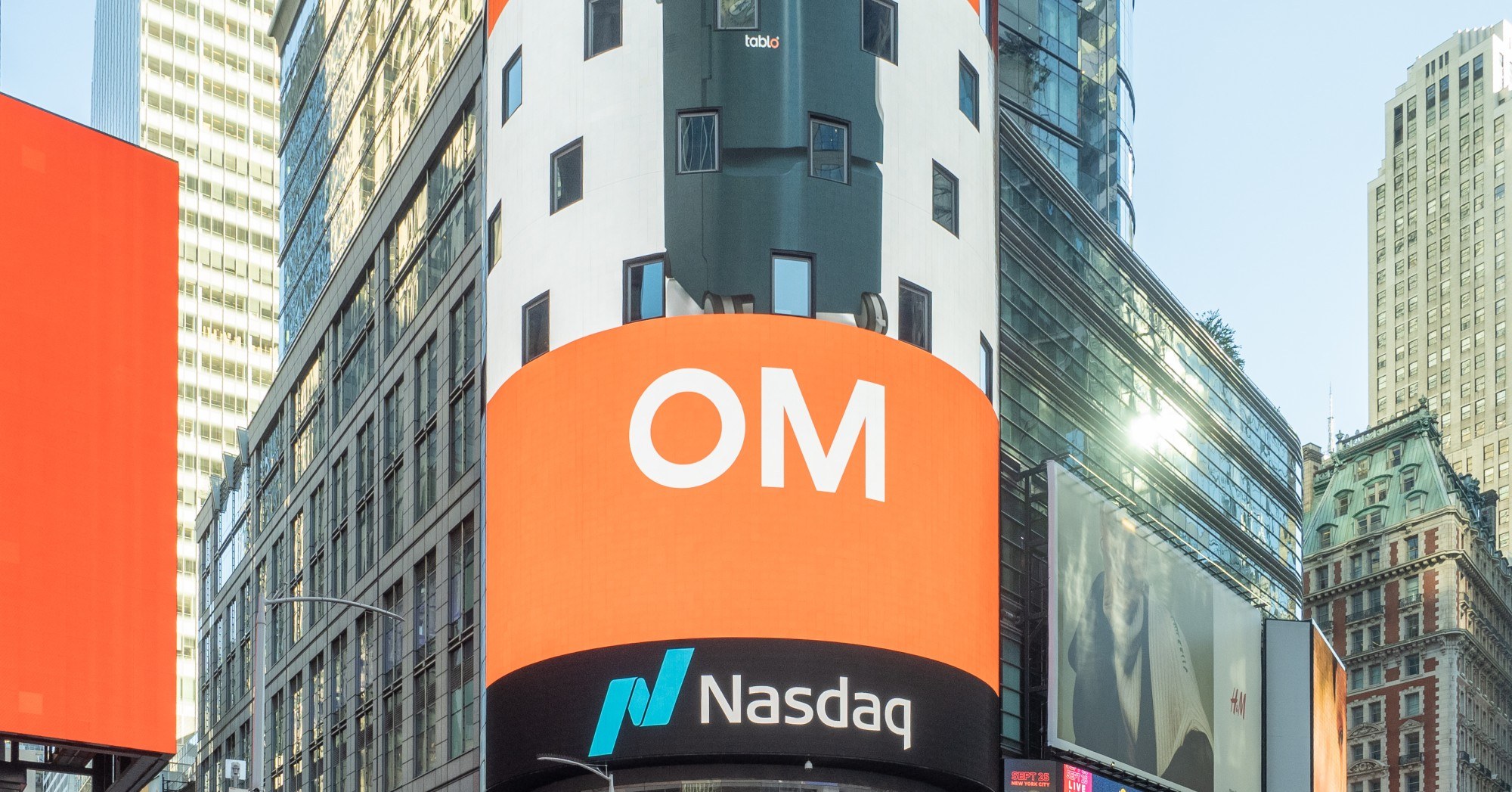
Top image: The Nasdaq MarketSite in Times Square. Okta trades on Nasdaq under the ticker OKTA. Photo: ajay_suresh / CC BY 2.0 via Wikimedia Commons
Okta, the San Francisco company that manages logins for corporate workforces and customer apps, will become a member of the S&P 500 before trading opens on Wednesday, Nov. 4. The change was announced by S&P Dow Jones Indices on Oct. 30.
Okta takes the place of Kenvue, the consumer-health company behind Tylenol and Band-Aid. Kimberly-Clark is acquiring Kenvue, which opens the slot. Okta is moving up from the S&P MidCap 400, and S&P puts it in the Information Technology sector.
How the reshuffle works
Joining the S&P 500 does not change anything about Okta’s business. What it changes is who has to own the stock. Funds that track the index must buy Okta shares in proportion to the company’s float-adjusted market value. Those funds also have to sell shares of the company leaving the index. That is why traders often watch the days between an announcement and the effective date.
S&P’s notice set off a chain of moves. Okta’s MidCap 400 seat goes to Glaukos, an eye-care device maker. Glaukos’s SmallCap 600 seat goes to McGrath RentCorp. In a separate change in the same notice, Loar Holdings takes LiveRamp’s place in the MidCap 400, because Publicis Groupe is acquiring LiveRamp.
The numbers behind the promotion
To join the S&P 500, a company must be profitable under generally accepted accounting principles (GAAP), among other tests. Okta’s most recent quarter meets that test. For the second quarter of fiscal 2027, which ended July 31, Okta reported:
- Revenue of $805 million, up 11% from a year earlier, and subscription revenue of $793 million, up 12%.
- Remaining performance obligations of $4.858 billion, up 17%. That figure counts contracted revenue Okta has not yet recognized. The current portion, $2.585 billion, rose 14%.
- GAAP net income of $116 million and free cash flow of $227 million.
- Cash, cash equivalents and short-term investments of $2.299 billion.
The company forecast third-quarter revenue of $813 million to $817 million and full-year revenue of $3.216 billion to $3.226 billion.
CNBC reported that the shares rose about 20% in after-hours trading on the results. At that point the stock was up about 55% for the year. On the call, CEO Todd McKinnon talked about the roughly $200 million Permiso acquisition. “You’ll see us do more of these tuck-in things,” he said.
A company that sells to the AI build-out
Okta’s pitch to investors has shifted toward what the industry calls non-human identities. These are the software agents, service accounts and API keys that now sign into corporate systems alongside employees. The more AI agents a company runs, the more credentials it has to govern. Okta argues that this makes identity a growing budget line rather than a mature one. Investors have bought that argument this year. Still, Okta’s growth rate has settled in the low teens, far below the hypergrowth years before its 2017 listing and the slowdown that followed.
That puts Okta in a different part of the AI trade from the companies the Chronicle covered this weekend. Alphabet’s capital spending and OpenAI’s funding round are about building AI capacity. Okta collects subscription revenue from companies that are adding AI agents to their systems.

The local footprint
According to its most recent annual report, Okta’s headquarters is at 100 First Street in San Francisco. It reported 6,366 employees as of Jan. 31 and fiscal 2026 revenue of $2.919 billion. Unlike a merger or an IPO, index inclusion brings no direct hiring. Over time, though, a larger and steadier shareholder base tends to lower a company’s cost of equity. For a company that is buying startups, that makes it easier to pay with stock.
The long view
Wednesday’s change adds one more Bay Area software company to the benchmark that most American retirement accounts track. The pattern in Silicon Valley’s 2026 market has been concentration: a few giant AI spenders driving the indexes. Okta’s entry is a smaller case of the same logic. Once a company shows GAAP profits and a steady subscription base, the index buys in. Whether that holds will depend on the guidance Okta gives when it next reports, and on whether its bet on AI-agent security turns into faster growth.





Leave a Reply