
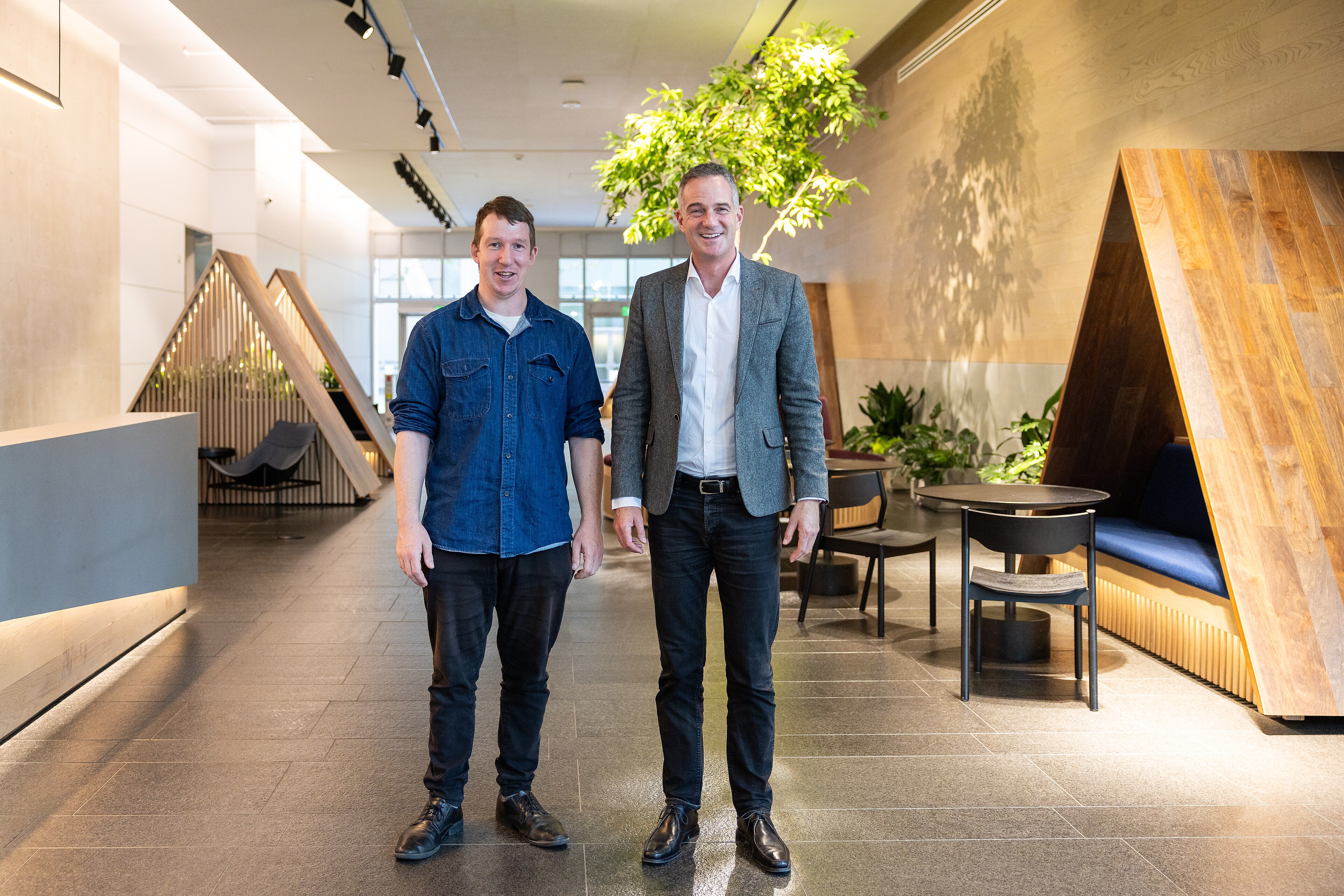
Top image: Then-U.K. Science and Technology Secretary Peter Kyle during a 2024 visit to Anthropic’s San Francisco offices. Photo: Department for Science, Innovation and Technology / CC BY 2.0 via Wikimedia Commons
For most of Silicon Valley’s history, its great fortunes reached the public through foundations: a founder sold stock, endowed a 501(c)(3) and made grants. Over the past week, three announcements pointed to a different model, one in which the asset itself, a share of a private technology company, is what gets given away.
On Oct. 18, Anthropic announced a public benefit fund that would hold a block of the AI company’s equity. A day later, Elon Musk said he would give one SpaceX share to every child in the United States next year, and the White House and the Treasury secretary pointed to the federal Trump Accounts program as the vehicle. By Oct. 22, The Washington Post estimated that pledges by Musk and his AI rivals had passed $300 billion.
These are pledges, not payments, and their value depends on share prices that have not yet been tested by time. But the structures matter, because they decide who controls the money and who receives it.
The Treasury’s view: generational wealth for children
Musk appeared to suggest his gift could land in Trump Accounts, the children’s investment accounts created by Congress and administered by the Treasury, CNBC reported. On Oct. 1, the Treasury announced that automatic enrollment was complete. Eligible children receive a $1,000 federal seed deposit once the account is claimed through the Trump Accounts app.
“This is a transformative milestone in the Trump Administration’s effort to give every American child the opportunity to build generational wealth and jump-start their financial future,” Treasury Secretary Scott Bessent said in the release.
A Treasury official told CNBC that the account rules are intended to build long-term wealth for children, especially in lower-income families, and to encourage donations. “The major donors we’ve engaged are motivated by a desire to help children build generational wealth and get a head start on their financial future,” the official said in a written statement to CNBC. The program now covers about 70 million accounts, more than 60 million of them opened automatically, CNBC reported. Michael and Susan Dell have pledged $6.25 billion, and about four dozen employers have committed to contributions. White House and Bessent posts on X cited Musk’s gift as a benefit to Trump Accounts holders, according to CNBC.
Musk’s pledge
Musk announced on X on Oct. 19 that he would give one SpaceX share to every U.S. child next year. “This will be the first of many,” he wrote, CNBC reported. With about 72 million children in the country and SpaceX shares closing at $146.03, CNBC estimated the gift’s value at about $10.5 billion. Musk owns about 4.8 billion SpaceX shares, or 6.4 billion including awards, a 48.4% stake, according to CNBC.
Brad Gerstner, the Altimeter Capital founder whom CNBC described as an architect of the program, called it “the largest philanthropic gift in history” in a post on X, citing “70 M accounts.” Musk thanked Gerstner on X for “helping enable this,” CNBC reported.
Musk also offered an argument about structure. Replying to Anthropic’s announcement, he wrote: “I recommend giving the shares directly to the public.” In another post cited by Reuters, he wrote: “Yes, giving shares, which are stakes in the future economy, directly to the people is the way.”
Musk is not alone at SpaceX. President Gwynne Shotwell and her husband have pledged SpaceX stock to more than 2 million children through Trump Accounts, according to Reuters.
The questions about the rules
Under the Treasury’s temporary rules for the accounts, known as 530A accounts in the tax code, families cannot decline gifted stock and generally cannot sell it until the earlier of five years or the end of the year the child turns 17, CNBC reported. The Treasury’s rule on the accounts was published in the Federal Register on Sept. 30.
Some tax specialists have raised questions about that design. “It’s the donor that’s dictating the terms of the gift,” Carolyn Schenck, an attorney and former national fraud counsel at the IRS, told CNBC. Adam Michel of the Cato Institute, a libertarian think tank, said: “Musk’s gift would be incredibly generous, but it doesn’t change the fact that Congress intended these accounts to be diversified.” Jane Ditelberg of Northern Trust told CNBC she saw room for a legal challenge to the rules. Representatives for Musk, Gerstner and the Treasury did not respond to CNBC’s requests for comment on the proposed gift.
The two sides agree that the gift is large. The disagreement is narrower: whether a single-company stock gift, locked in for years, fits a program that, in Michel’s reading, Congress intended to be diversified. That is a question for regulators and possibly courts, not a question about the donors’ generosity.
Anthropic’s model: an equity fund with flexible tools
Anthropic’s announcement takes a different route. The company is creating the Anthropic Public Benefit Fund, a wholly owned limited liability company. Subject to stockholder approval, the fund would receive 5% of Anthropic’s shares, plus an additional 2% at the board’s discretion for every 50% increase in the company’s value above a baseline.
Anthropic said the fund has already committed $200 million to work on AI’s effects on the labor market. Its possible uses include “large donations to traditional nonprofits or direct distributions to specific populations,” the company wrote. On Musk’s point, then, the two approaches overlap more than the exchange on X suggests: Anthropic’s fund leaves direct distribution open as an option.
The company said it chose an LLC rather than a 501(c)(3) charity to keep the structure adjustable. Unlike a private foundation, an LLC is not subject to a federal minimum-payout requirement or the annual public Form 990-PF filing, which means less public reporting by default. Anthropic addressed one concern directly: “None of the Anthropic equity held by the LLC will be used for lobbying or political giving.” It said details on the fund’s structure, governance and milestones would be disclosed “in the coming months,” along with a public benefit report.
The company also pointed to its staff. Anthropic’s co-founders have pledged 80% of their equity to charity, and about half of employees participate in a donation-matching program, which together account for roughly 20% of the company’s shares, according to the announcement.
OpenAI’s foundation and the rest of the field
OpenAI went first. After its restructuring in October 2025, the OpenAI Foundation held a 26% stake in the company, worth about $130 billion at the time, plus a warrant that pays out if the share price rises more than tenfold over 15 years, according to Reuters. The foundation has committed $25 billion to health, curing disease and AI resilience, building on a $50 million commitment in July 2025. The Post reported that the foundation has distributed $855 million since March.
Reuters’ comparison with earlier philanthropy puts the numbers in context:
- Gates Foundation: $102.3 billion paid out over 25 years, with plans for $200 billion more through 2045 and a record $9 billion in 2026.
- Warren Buffett: more than $47 billion given to the Gates Foundation and more than $17 billion to family charities, with 99.5% of his estate directed to a trust.
- MacKenzie Scott: a stake of about $36 billion, and $7.1 billion given in 2025.
- Ford Foundation: started in 1936 with $25,000, now about $18 billion in endowment, and $768 million in grants in 2024.
- Lilly Endowment: founded in 1937 with 17,500 shares worth $262,500, now nearly $106 billion in assets after paying out $3.85 billion in 2025.
- Novo Nordisk Foundation: DKK 11.8 billion, about $1.77 billion, awarded in 2025.
Reuters also noted the policy backdrop: Sen. Bernie Sanders has introduced a bill that would give the public a 50% stake in the largest AI companies.
Why Silicon Valley should pay attention
The Lilly and Novo Nordisk examples are the closest precedents. Both were built on a single company’s stock and grew with it. That is the bet Anthropic and OpenAI are making: that equity in a frontier AI company, given early, will compound into one of the largest charitable pools in history. Musk’s version spreads the same bet across tens of millions of households instead of concentrating it in one institution.
For the Peninsula’s giving class, which the Chronicle has covered from gala season to the Chan Zuckerberg Community Fund’s local grants, the change raises practical questions. Community nonprofits in Santa Clara and San Mateo counties have historically benefited when founders sold stock and endowed local foundations. Equity held inside a company LLC, or distributed as single shares to children nationwide, does not automatically reach a food bank in East Palo Alto or a clinic in East San José.
The long view
The great Valley fortunes of the last generation took decades to turn into philanthropy. The AI generation is committing equity before its companies have finished growing, and in some cases before they have gone public. That has real advantages: the gifts can grow with the companies, and recipients share in the upside. It also concentrates risk. A pledge measured in shares is only as large as the stock price on the day it is used. The useful questions for the next few years are concrete. When will Anthropic publish its governance rules and first benefit report? What does the OpenAI Foundation pay out each year? And will Treasury’s final rules on Trump Accounts let families diversify gifted stock? The answers will determine whether these pledges become the largest transfer of private wealth to the public in history, or a set of large numbers that changed with the market.
Sources
- Anthropic, announcement of the Anthropic Public Benefit Fund, Oct. 18, 2026
- U.S. Department of the Treasury, press release sb0642, Oct. 1, 2026
- Federal Register, “Trump Accounts,” Sept. 30, 2026
- CNBC, Musk SpaceX share pledge, Oct. 19, 2026
- CNBC, Trump Accounts stock rules, Oct. 20, 2026
- Reuters (via Investing.com), factbox on Anthropic’s fund and other philanthropic efforts, Oct. 20, 2026
- The Washington Post, Oct. 22, 2026




Leave a Reply