
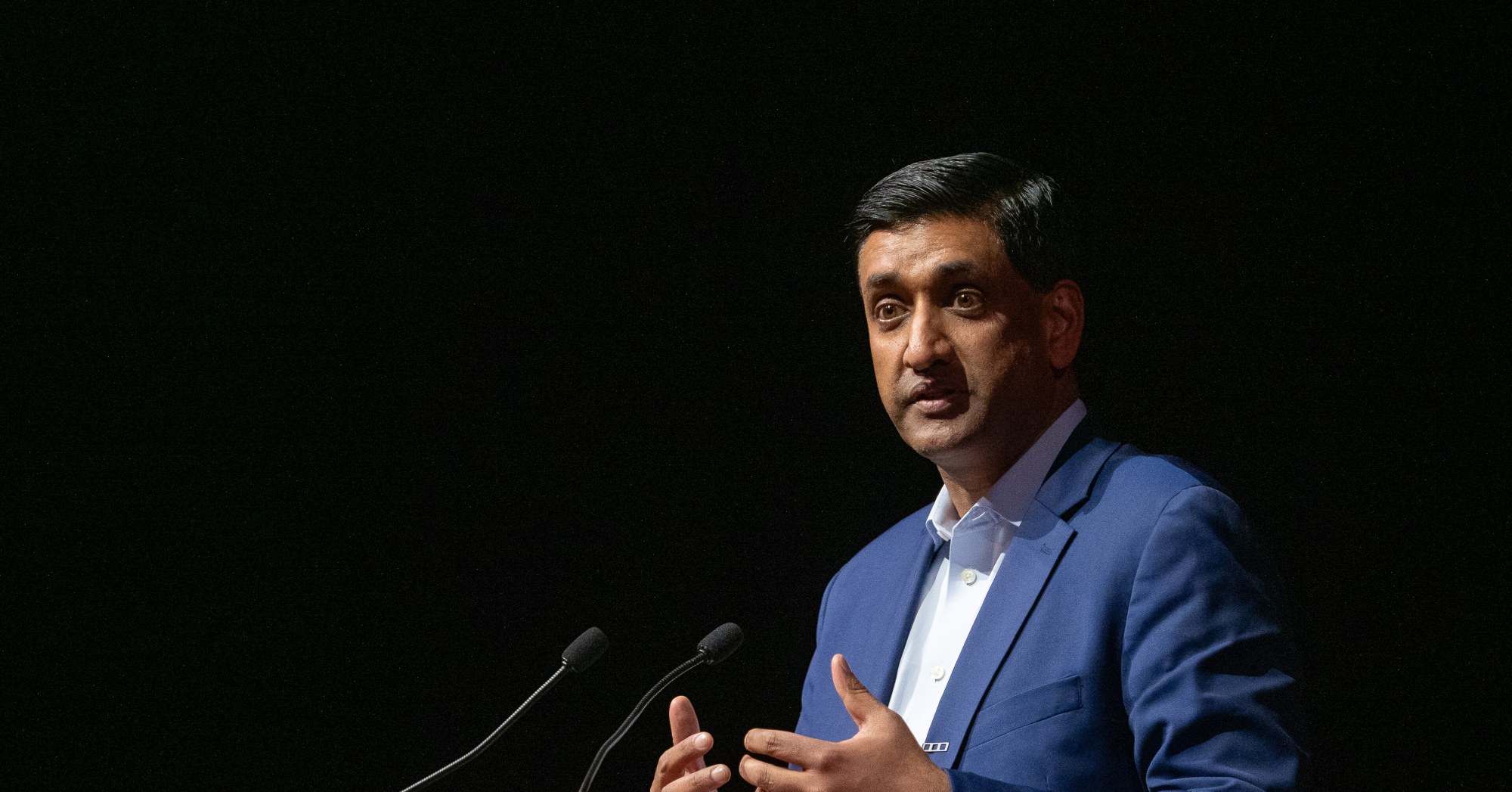
Top image: Rep. Ro Khanna (D-Fremont) speaks at Stanford University on Feb. 20, 2026. Photo: Anderseidesvik / CC BY-SA 4.0 via Wikimedia Commons
When President Trump used his State of the Union address to call on Congress to “pass the Stop Insider Trading Act without delay,” he singled out one Bay Area lawmaker by name. “Did Nancy Pelosi stand up? Doubt it,” he said, according to a White House release that quotes the speech.
Seven months later, the bill has passed the House and stalled in the Senate, and the Bay Area’s congressional delegation voted against it at every step. On July 22, the House approved H.R. 7008 by 232 to 198, according to the House Clerk’s roll call. Every Bay Area member who voted cast a no vote, among them Pelosi, Ro Khanna, Zoe Lofgren, Sam Liccardo and Kevin Mullin. On Sept. 30, a motion to open debate on the bill in the Senate failed 53 to 47, short of the 60 votes needed. Sens. Alex Padilla and Adam Schiff were among the no votes, according to the Senate roll call.
Republicans say the votes speak for themselves. Democrats from the region say they back a trading ban but objected to what the bill does and does not include. Here is what is in the measure, how the votes broke and what each side argues.
What the bill does
H.R. 7008 was introduced by Rep. Bryan Steil (R-Wis.), chairman of the House Administration Committee, and had 93 cosponsors, according to Congress.gov. As reported by the committee, it would bar members of Congress, their spouses and dependent children from buying covered investments such as individual stocks. Members would have to give public notice 7 to 14 days before selling. Violations would carry a fee of the greater of $2,000 or 10% of the transaction, plus any gains. Widely held investment funds and certain trusts are exempt.
The bill also contains election provisions. The White House release describes a requirement for photo identification to vote in federal elections. The Associated Press reported that Democrats objected to that voter-ID provision and to the fact that the trading ban would not apply to the president.
The vote
In the House, Republicans voted 218 to 0 for the bill and Democrats voted 198 to 13 against it, with one Democrat not voting, according to the Clerk’s tally. Rep. Kevin Kiley, listed as an independent, voted yes. The East Bay’s 14th District seat was vacant at the time; Rep. Aisha Wahab was sworn in on Sept. 2.
These Bay Area members voted no: Jared Huffman, Mike Thompson, John Garamendi, Josh Harder, Mark DeSaulnier, Nancy Pelosi, Lateefah Simon, Kevin Mullin, Sam Liccardo, Ro Khanna, Zoe Lofgren and Jimmy Panetta.
In the Senate, the Sept. 30 cloture vote on the motion to proceed broke along party lines except for Sen. John Fetterman (D-Pa.), who joined the 47 no votes, the Senate tally shows.
The Republican and White House case
The White House argues that the vote exposed Democrats’ real position. Its Sept. 30 release, titled “Democrats Unanimously Vote Against the Stop Insider Trading Act,” says nearly 90% of Americans support banning congressional stock trading and names Pelosi. “Look no further than Nancy Pelosi as proof that a stock trading ban is necessary to stop corruption at the highest levels and restore the public’s trust,” the release says. It describes the photo-ID requirement as “a commonsense provision” meant “to ensure that only American citizens vote in American elections.”
In the State of the Union, Trump framed the bill as part of a broader economic message. “As we ensure that all Americans can profit from a rising stock market, let’s also ensure that members of Congress cannot corruptly profit using inside information,” he said, according to the release.
The bill did draw some Democratic support: 13 House Democrats voted for it. In the Senate, seven more votes would have been enough to reach the 60 needed to begin debate.
The Democrats’ case
Bay Area Democrats say they were asked to vote for an election bill wrapped inside an ethics bill. “Republicans attached the SAVE Act to a congressional stock trading ban, knowing it will make passage impossible in the Senate. This is why Americans hate politics,” Khanna, who is weighing a 2028 presidential bid and is widely seen as a likely contender for the 2028 Democratic presidential nomination, wrote on Bluesky.
Khanna and Mullin were among the House Democrats who signed an Aug. 4 letter to Speaker Mike Johnson calling H.R. 7008 “a voter suppression bill and a half-measure.” The letter argues that the bill “would still allow Members of Congress to own and sell stocks” and does not cover President Trump, and it urges a vote on a Democratic alternative, the Restore Trust in Government Act (H.R. 6731). That bill, from Rep. Seth Magaziner (D-R.I.), would ban trading by members of Congress, the president and the vice president. Garamendi is the only Bay Area member among its 95 cosponsors, according to Congress.gov. That bill has not received a floor vote.
What happens next
The Senate vote leaves H.R. 7008 on the Senate calendar. Majority Leader John Thune could bring it back, but it would still need 60 votes to advance. Democrats could get their own alternative to the floor only if House leaders schedule it. With a lame-duck session coming after the Nov. 3 election and Pelosi not seeking reelection, the stock-trading fight is likely to remain part of the campaign debate in the region and nationally.



Leave a Reply