
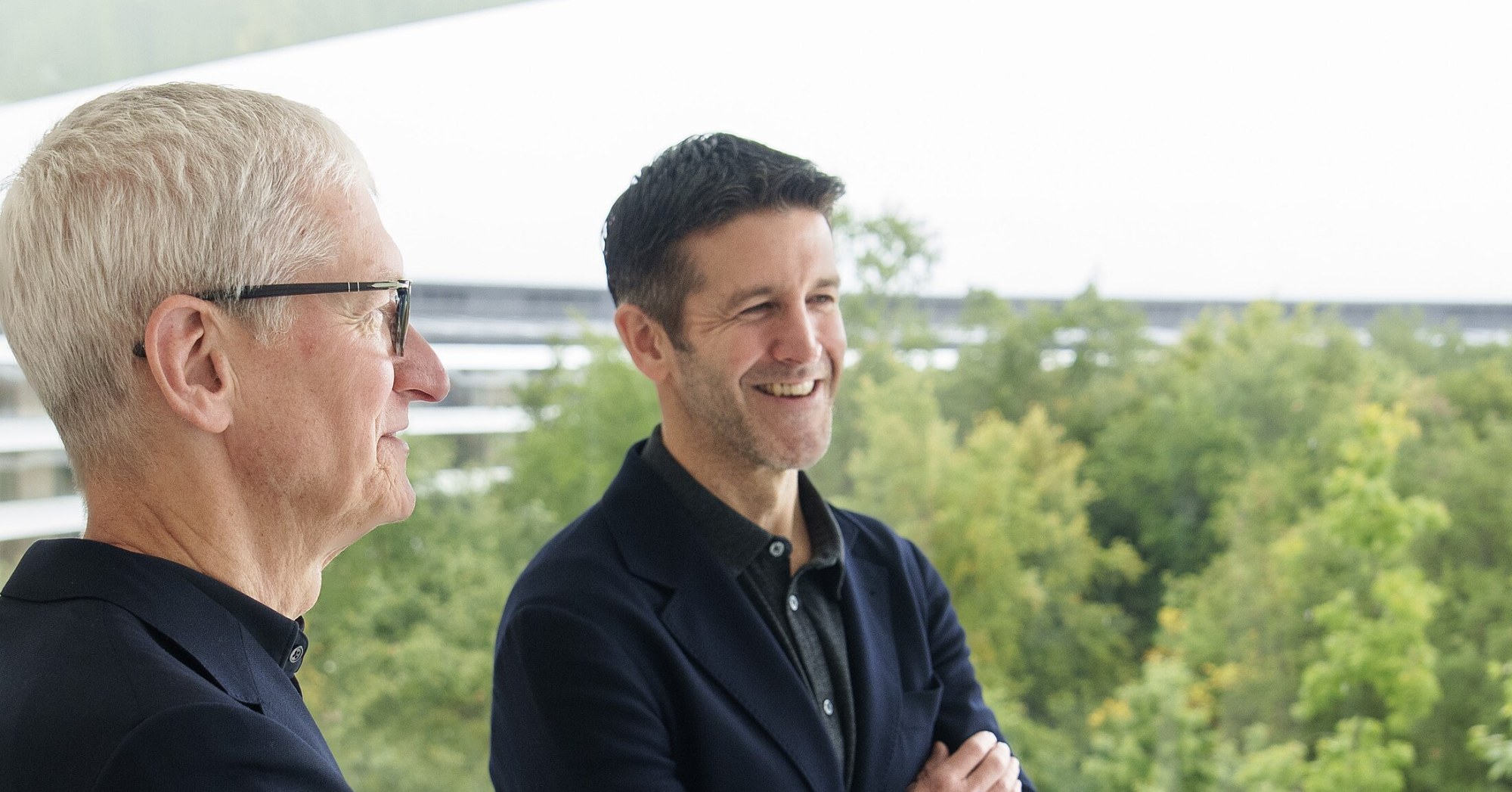
Top image: John Ternus, right, and Tim Cook during a May 2026 meeting with European Parliament President Roberta Metsola. Photo: Amy Osborne / European Union, © European Union 2026 – Source: EP, via Wikimedia Commons
On Monday, Nov. 2, at 2 p.m. Pacific, John Ternus will lead Apple’s quarterly earnings call for the first time as chief executive, according to the company’s investor-relations page. The call covers Apple’s fiscal fourth quarter, which ended in late September. That month Apple unveiled the iPhone Duo, its first foldable phone. It is the first look investors will get at how the Cupertino company’s new leader talks about results.
Ternus, an engineer who has spent his career in Apple’s hardware organization, succeeded Tim Cook on Sept. 1. Cook, who had been CEO since 2011, is now executive chairman. Here is what the public record shows.
How he got the job
Apple’s board appointed Ternus on April 17, according to the company’s April 20 filing with the Securities and Exchange Commission. Apple said in its announcement that the board approved the transition unanimously after “a thoughtful, long-term succession planning process.” The filing gave Ternus’s age as 50. Arthur Levinson, the board’s non-executive chairman for 15 years, became lead independent director.
“I am profoundly grateful for this opportunity to carry Apple’s mission forward,” Ternus said at the time. “Having spent almost my entire career at Apple, I have been lucky to have worked under Steve Jobs and to have had Tim Cook as my mentor.”
Cook said Ternus “has the mind of an engineer, the soul of an innovator, and the heart to lead with integrity and with honor.” Apple said Cook, as executive chairman, would help with “certain aspects of the company, including engaging with policymakers around the world.”
Career
According to his Apple biography, Ternus worked as a mechanical engineer at Virtual Research Systems before joining Apple’s product design team in 2001. He became a vice president of hardware engineering in 2013 and joined the executive team in 2021 as senior vice president of hardware engineering. Apple credits him with a central role in introducing the iPad and AirPods and with many generations of iPhone, Mac and Apple Watch. He holds a bachelor’s degree in mechanical engineering from the University of Pennsylvania.
In a TIME profile published Oct. 15, Andrew R. Chow reported that Ternus was born in 1975 in Orange County. Analyst Neil Cybart of Above Avalon told TIME that Ternus “has been a big believer in this design-first culture that defines Apple.”
What he will be paid
An amended filing on Sept. 1 set out the pay terms:
- Ternus’s annual salary rose to $3 million on Sept. 1.
- He received a prorated restricted stock unit award with a target value of $2.5 million for his partial year as CEO in fiscal 2026.
- The board’s People and Compensation Committee approved an annual equity award for fiscal 2027 with a target value of $55 million. Three-quarters of it is performance-based and vests according to Apple’s total shareholder return relative to other S&P 500 companies. The other quarter vests over four years.
- Cook’s salary as executive chairman is $2 million, effective Sept. 26. He is to receive a fiscal 2027 equity award with a target value of $45 million, split evenly between performance-based and time-based units.
How he is running the company
Ternus has begun reshaping the executive ranks. MacRumors, citing Bloomberg, reported Oct. 8 that Apple veteran Steve Smith has taken over mergers, acquisitions and corporate development from Adrian Perica and will report to Chief Financial Officer Kevan Parekh. Perica remains in charge of iCloud, Fitness+ and Apple News under services chief Eddy Cue. Carson Oliver was promoted to vice president of the App Store.
The Mac Observer, also citing Bloomberg’s Mark Gurman, reported that Parekh is handling much of Apple’s financial operation and Chief Operating Officer Sabih Khan the supply chain. Meanwhile, Ternus is spending more of his time with hardware and design teams. Apple has not publicly described a division of responsibilities.
In his own words
In his interviews with TIME, Ternus addressed several issues investors may ask about.
Memory chips. TIME reported that a global shortage of memory chips has raised costs and delayed production, and that the Financial Times reported in July that Apple had begun testing memory chips from a Chinese company. A bipartisan group of senators objected in a letter, arguing the move would imperil national security. “The constraints in memory are absolutely a crisis,” Ternus told TIME. “So our fundamental belief is that all options should be on the table.”
Washington. Ternus said he has met with members of the Trump administration to “make sure we’re kind of working through things together.” TIME reported that Cook has continued to represent Apple internationally, including attending President Trump’s state dinner for Xi Jinping. “He has great relationships and loves Apple,” Ternus said of Cook. “So wherever he can help, he is happy to help.”
AI. According to TIME, Apple’s new Siri, launched in the U.S. in September, runs on an Apple model that draws on Google’s Gemini technology. Ternus rejected the idea that this is a retreat from Apple’s practice of building its own core technology. “There’s not really a goal that we have to make every single thing in a product,” he said. “We make the things where we can really bring differentiation.”
Devices. “People want physical things,” Ternus said. “So I don’t see a scenario where all of a sudden, our devices disappear and we don’t have a need for an iPhone.”
Open questions
TIME reported that Apple sued OpenAI in federal court in July, alleging theft of hardware trade secrets; OpenAI calls the lawsuit “baseless.” Analysts will also want to hear about early demand for the Duo, whose launch and effect on Apple’s market value the Chronicle covered here, and about AI spending and memory costs.
“You can’t do everything,” Ternus told TIME. “So we kind of try to constrain ourselves to the stuff that matters most—and then put all of our effort into those things.”






Leave a Reply