
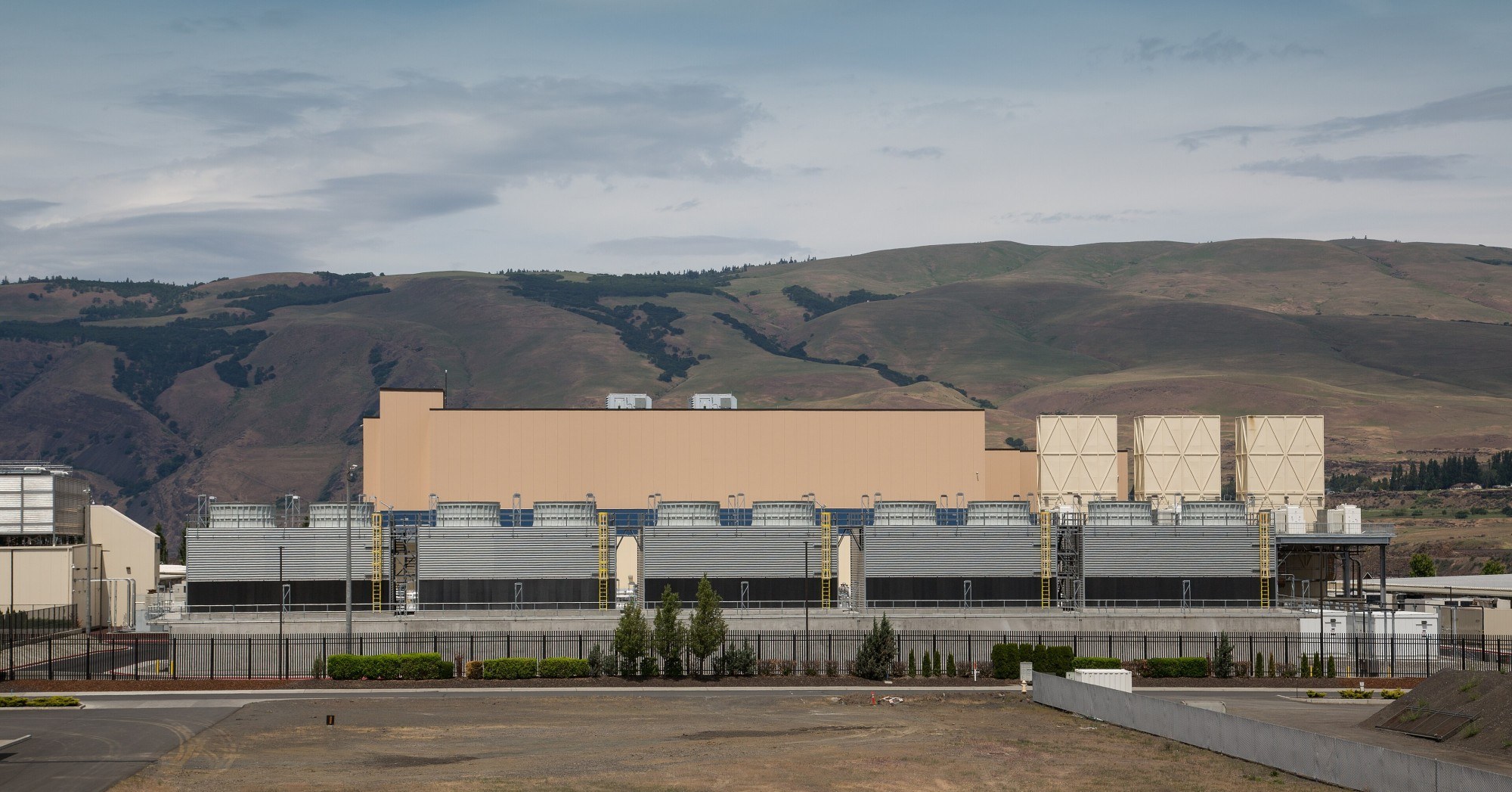
Top image: Google’s data center campus in The Dalles, Oregon, photographed in May 2015. This is not the proposed San Jose project, for which no licensed photo is available. Photo: Tony Webster from Minneapolis, Minnesota, United States / CC BY 2.0 via Wikimedia Commons
Google’s plan for 5079 and 5087 Disk Drive in Alviso could reach a decision before San Jose finishes the rules meant to govern projects like it. Deputy City Manager Manuel Pineda said the project could come up for approval before the end of the year, San José Spotlight reported Sunday. The City Council is expected to vote on data center development standards in December, and projects approved before then would be exempt from them.
The site plan calls for demolishing an existing warehouse and parking lot and building up to three research and development facilities totaling nearly 483,000 square feet, according to Spotlight. Google has called the project a research and development lab, and the city has called it a “large-energy use project” distinct from a data center. Spotlight reported that the architectural plans show an onsite substation and switching station with three transformers, multiple generator yards and cooling stations. Officials don’t plan a full environmental review and will instead rely on California Environmental Quality Act reports from 2000 and 2013.
What the state’s draft says
The California Public Utilities Commission’s paperwork treats the load as a data center. Draft Resolution E-5455, on the commission’s Nov. 19 agenda, would approve, with modifications, an agreement for PG&E to serve “a new 250 megawatt (MW) data center load” for Google at 230 kilovolts at 5079 Disk Drive.
The document puts the size in regional terms: 250 megawatts “is larger than the average demand of all of Marin county in 2024, and about half the overall average demand of San Mateo county.” Google applied to interconnect on March 3, 2025, and PG&E filed the agreement on Dec. 18, 2025. PG&E asked for approval by June 1, 2026, to support construction beginning in January 2027 and an in-service date in December 2028.
The draft’s main change is money up front. It would require Google to post “an additional capital advance of $600,000 per MW,” which works out to $150 million for 250 megawatts, and would cap annual refunds to Google at 100% of the net revenue PG&E actually collects from it. PG&E’s public cost estimate for the portion Google will build itself is $64 million to $137 million, before a tax component.
The ratepayer argument
The Public Advocates Office, the CPUC’s ratepayer watchdog, protested the original deal in January. It argued that the standard refund formula could repay Google “well before” its electric bills cover the cost of connecting it. The advocates also pointed to LS Power’s Newark-NRS 230-kilovolt line, which they called a “more than $1 billion project.” The draft says the Google facility will connect directly to that line. Its revenue requirement, paid by ratepayers across the state grid, is capped at $102 million in year one, falling to $41 million by year 40. The draft adds that Energy Division data requests confirmed Google’s load “depends on more than 10 other significant transmission upgrades in the South Bay region.”
PG&E disagrees with that framing. It argues that “the LS Power upgrades are moving forward with or without the proposed Google facility,” that the state grid operator identified them before Google applied, and that “thousands of residential and commercial customers” will benefit.
Google, the City of San José, the Bay Area Council and the Silicon Valley Leadership Group were among the parties that filed comments in June. Most commenters objected to an earlier draft that left cost decisions to a pending statewide rulemaking with no set end date. The Bay Area Council, the Silicon Valley Leadership Group and the developer Westbank said that uncertainty makes projects hard to finance. The commission says the fixed $600,000-per-megawatt figure “strikes a balance between protecting ratepayers and providing certainty.” Spotlight reported that Google would ultimately be reimbursed in full over 15 years, a cost borne by ratepayers.
What San Jose’s standards would require
The draft city standards would encourage data center developers to enroll with San Jose Clean Energy, hold diesel backup generators to the strictest federal emission standards and run them only during outages, require annual water and electricity reports, and require an independent audit every five years, according to Spotlight. Sixteen data centers and large energy-use projects are approved or in the pipeline, and five were submitted in the two months after staff began drafting standards in June.
Mayor Matt Mahan declined to tell Spotlight how the city would make sure projects approved before the standards address health and environmental concerns. Ellina Yin, founder of the civic group Dreaming Collaborative, said: “There is definitely a rush.” She noted that a planning director’s hearing does not go to the Planning Commission unless someone appeals.
The long view
San Jose is trying to be two things at once: the place where AI infrastructure gets built, and the city with what the mayor has called the strictest data center standards in the country. The Disk Drive case shows the sequencing problem. Power deals are set in Sacramento on a utility’s timeline, while land-use rules are written at City Hall on a council’s. The same grid squeeze is behind Apple’s North San José substation carve-out, which the council takes up Tuesday, and San Mateo County’s data center zoning debate. Whatever the CPUC decides Nov. 19, it will set a reference price for what a megawatt of South Bay demand owes the grid before it’s switched on. Next date to watch: the commission’s Nov. 19 meeting, then the council’s December vote on standards.
Sources
- California Public Utilities Commission, Draft Resolution E-5455 (PG&E Advice Letter 7785-E, Google LLC), for the Nov. 19, 2026 meeting
- San José Spotlight, “Google data center could be approved before San Jose sets standards,” Nov. 9, 2026
- South Bay Chronicle, Apple North San José development agreement and PG&E substation, Nov. 9, 2026



Leave a Reply