
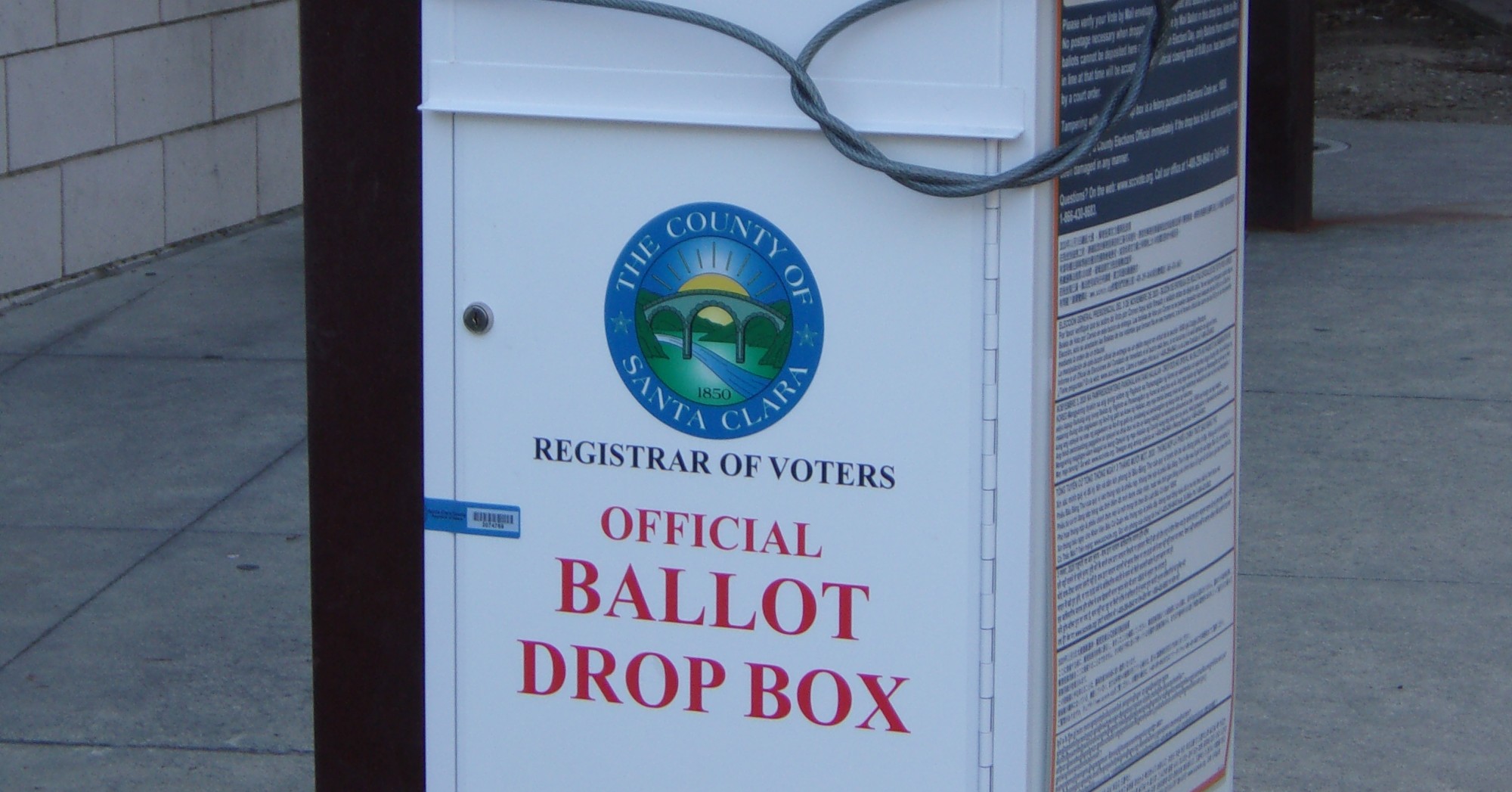
Top image: A Santa Clara County Registrar of Voters ballot drop box in San José during the 2020 general election. Photo: Yngvadottir / CC BY-SA 4.0 via Wikimedia Commons
A federal appeals panel is scheduled to hear arguments at 1 p.m. Pacific time Sunday in the Justice Department’s emergency bid to make California set aside mail ballots from people federal investigators say are noncitizens, the latest turn in a fast-moving legal fight that reached Santa Clara County’s election office this week.
The dispute, United States v. California, No. 26-7070 in the U.S. Court of Appeals for the Ninth Circuit, will be argued for about an hour, according to Election Law Blog. The panel will also take up Los Angeles County’s motion to dismiss the appeal. The Chronicle on Saturday reported on the department’s letters to counties and Sen. Alex Padilla’s demands for its methods.
The administration’s case
The Justice Department’s position is that it is asking for a narrow, temporary step to protect citizens’ votes. “We’re not asking California to take any drastic steps other than to sequester the ballots from the suspected noncitizens,” Bill Essayli, the first assistant U.S. attorney for the Central District of California, told Fox News Digital. “We believe it’s at a minimum of 20,000. That’s the floor.”
Essayli said every person on the current list was individually reviewed by a federal employee at U.S. Citizenship and Immigration Services and Homeland Security Investigations, and that he expects thousands more names to be added. He argued the matter is urgent because ballots are already being returned. “So, the crime is occurring in real time,” he said. “One illegal vote cancels out the vote of an American citizen. There are a lot of local elections that are decided on very few votes. Noncitizens cannot vote in federal elections, and we intend to enforce that law.”
When the department filed suit on Oct. 15, its announcement said Homeland Security Investigations and federal partners had analyzed publicly available voter-registration records and compared them with federal immigration data using “multiple data-enrichment and verification methods.” The department said it sent California the names of more than 20,000 people it believes are likely noncitizens who were sent vote-by-mail ballots, and asked the state to review the list. “California election officials were given an opportunity to remove noncitizens from their voter rolls and to sequester ballots returned from suspected ineligible voters. They refused,” Essayli said in the release.
Attorney General Todd Blanche called the matter “state-facilitated voter fraud.” Homeland Security Secretary Markwayne Mullin described the analysis as preliminary and ongoing and said that “even one noncitizen vote cancels out the ballot of an American citizen.” The lawsuit asks the court to require California to set aside ballots from people on the federal list and to verify their citizenship, independently or with federal help, “beyond relying on unverified statements of citizenship,” before counting them.
Essayli has said the department moved when it did because investigators did not know exactly which voters would receive ballots until they were sent. He has also said California could speed the process by sharing identifying data such as driver’s license and Social Security numbers for cross-checking against federal databases. “They’re forcing us to do it the hard way, which we’re willing to do because this is very important,” he told Fox News Digital.
How it reached the appeals court
The department turned to the Ninth Circuit after U.S. District Judge David O. Carter did not rule by a deadline it had requested, Fox News reported. “This is an emergency,” said the filing, signed by Blanche and Essayli. “Every minute of processing that occurs without segregating the ballots of suspected non-eligible voters causes untraceable disenfranchisement and dilution of the votes of United States citizens.”
The appeals court ordered California to respond by noon Saturday. In a separate order Saturday, it directed the department to answer Los Angeles County Registrar-Recorder Dean C. Logan’s emergency motion to dismiss the appeal for lack of jurisdiction by 9 a.m. Pacific time Sunday. A hearing before Judge Carter in the district court remains scheduled for Tuesday, according to Fox News.
California’s response
In its opposition, filed Saturday by Attorney General Rob Bonta’s office, the state argued that the appeals court lacks jurisdiction because the district court has not issued any order, and that the department has no standing, no cause of action and no basis to alter election procedures while voting is underway. Mail ballots have been cast and processed since Oct. 5, the state said, invoking the Supreme Court’s guidance against late changes to election rules.
The state argued that California already forbids noncitizen registration and voting, requires attestations of citizenship under penalty of perjury and criminalizes noncitizen voting. “Refusing to help is not the same as impeding,” it wrote, quoting a 2019 Ninth Circuit decision. It also challenged the reliability of the federal list, saying federal officials alleged in July that California “may” have some 190,000 noncitizens on its rolls, did not respond when the state requested more information, and then sent an Oct. 13 letter about 20,000 voters. The state cited the federal government’s “utter failure to substantiate similar allegations” in Nevada.
A practical objection runs through the state’s filings. Under California law, once a mail ballot’s signature is verified, the ballot is separated from its envelope to protect secrecy, and it can no longer be traced to the voter. Los Angeles County alone had processed 331,000 ballots, according to court records cited by Fox News. Essayli acknowledged the point. “That is true. That’s why we’re getting an emergency court order requiring them to put those ballots aside,” he said.
Los Angeles County has also questioned the list’s accuracy. Monica Flores, an assistant registrar-recorder, said in a court declaration that in a sample of 200 records tied to county addresses, 112 corresponded to canceled or inactive registrations, so no ballot was mailed, and that among records with meaningful birthplace data, 38.9% listed a U.S. birthplace. Essayli disputed both points, saying the county did not say when the registrations were canceled and that birthplace data is self-reported. “If they’re canceling now based on the records we provided, that’s great news,” he said. “But that’s all to be determined.”
The Santa Clara County letter
The federal effort has now reached local election offices across the state. The Santa Clara County Registrar of Voters received a letter Friday asking for help identifying 902 registered voters in the county whom federal officials consider likely noncitizens, NBC Bay Area reported. The U.S. attorney for the Northern District of California asked the registrar to provide identifying information, including Social Security numbers associated with the names, within 48 hours. The letter warned that sending vote-by-mail ballots to people on the list or tabulating their ballots would constitute a federal crime.
“This certainly is a unique letter that we’ve gotten,” Registrar of Voters Matt Moreles told the station. “I can’t recall my 20-plus years in this county of receiving a letter like this from the Department of Justice.” He said the office was reviewing the letter internally and with county leadership before deciding next steps.
San Francisco received a similar letter. A spokesperson for City Attorney David Chiu called it “clearly another ploy to interfere with the election” and said the city was reviewing it, according to NBC Bay Area, which said it had not received a response from the Justice Department on why the letters were sent.
What to watch
- Whether the Ninth Circuit panel finds it has jurisdiction at all, given that the district court has not ruled.
- If the panel reaches the merits, whether it orders ballots set aside, and whether the state seeks an administrative stay and further review, as its filing signaled it would.
- Judge Carter’s hearing on Tuesday.
- How Santa Clara County and San Francisco answer the 48-hour requests, and whether other Bay Area counties disclose similar letters.
- Whether the federal list grows, as Essayli has predicted.
The long view
The case puts two legitimate principles in direct tension. The administration argues that noncitizen voting is illegal and that the only way to prevent it once ballots are mailed is to pause the counting of suspect ballots. California argues that states run elections, that its own safeguards are working, and that a late federal intervention based on an unverified list risks disenfranchising citizens. However the Ninth Circuit rules, the dispute is likely to shape how federal data and state voter rolls are matched in future elections. For Santa Clara County, the practical stakes are immediate: an election office with ballots already in hand must decide how to answer a federal demand that its registrar says he has never seen before.
Sources
- U.S. Department of Justice, emergency motion for injunction pending appeal, No. 26-7070, Oct. 23, 2026
- State of California, opposition to emergency motion, Oct. 24, 2026
- U.S. Court of Appeals for the Ninth Circuit, order, Oct. 24, 2026
- Election Law Blog, Oct. 24, 2026
- U.S. Attorney’s Office, Central District of California, Oct. 15, 2026
- Fox News Digital, Oct. 22, 2026
- Fox News Digital, Oct. 24, 2026
- NBC Bay Area, Oct. 24, 2026




Leave a Reply