
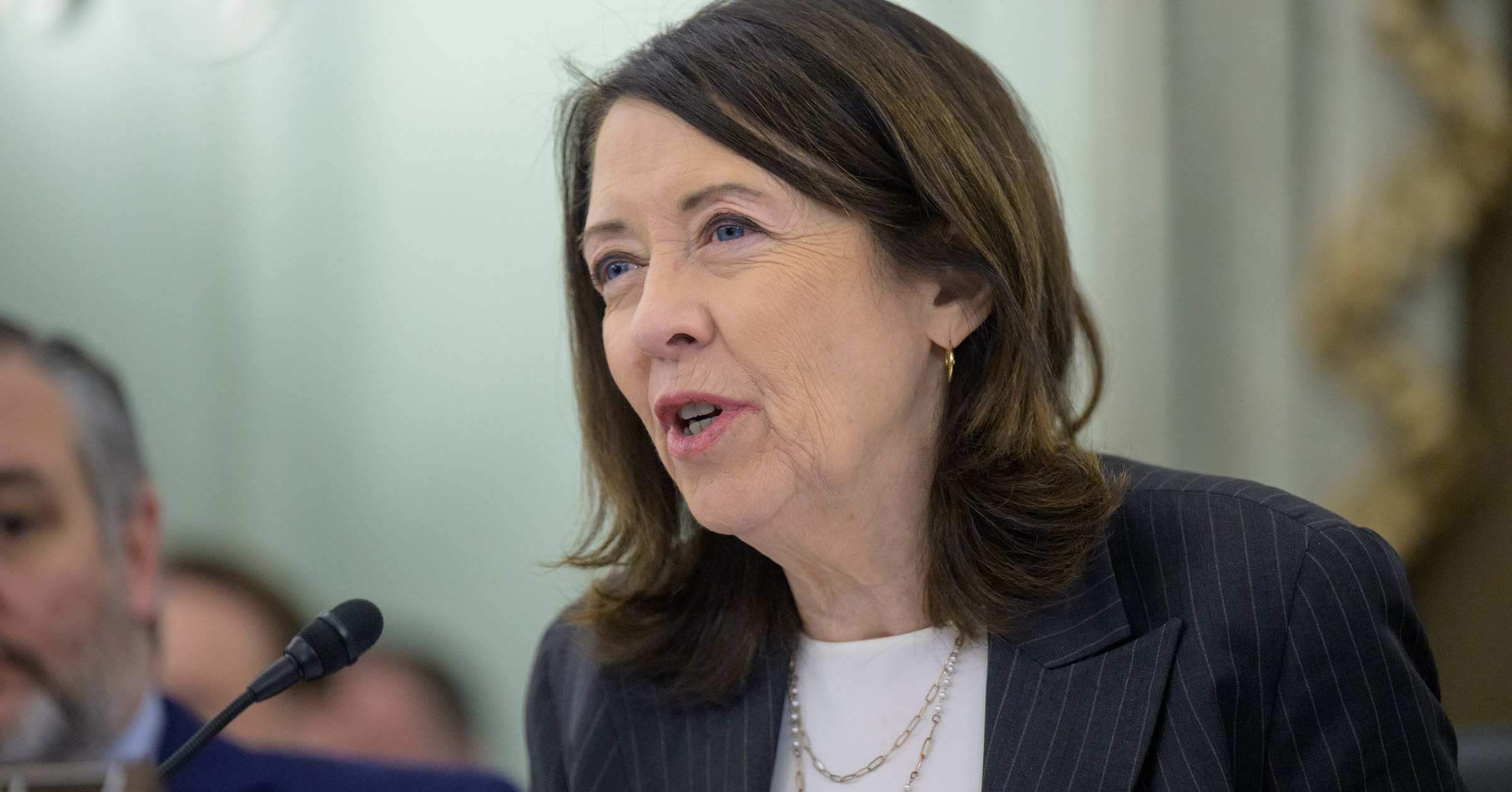
Top image: Sen. Maria Cantwell, D-Wash., the ranking Democrat on the Senate Commerce Committee, questions a witness at an April 9, 2025, committee hearing. Chairman Ted Cruz, R-Texas, is seated behind her. Photo: NASA/Bill Ingalls (public domain) via Wikimedia Commons
Silicon Valley’s biggest policy questions do not go only through Congress’s judiciary or financial committees. Two panels do much of the first drafting: the House Committee on Science, Space, and Technology and the Senate Committee on Commerce, Science, and Transportation. Those questions include how artificial intelligence should be tested, how much the government spends on research, who builds the next fusion machine and how the FCC spends money on internet access.
The South Bay Chronicle is starting regular coverage of both committees this week. This guide covers who holds the gavels, what each panel controls, the bills and disputes now on the table, and what could change after Nov. 3.
The House Science Committee
Rep. Brian Babin, R-Texas, chairs the House Science Committee, according to the committee’s majority website. The ranking Democrat is Rep. Zoe Lofgren of San José, who represents California’s 18th District and is the committee’s only Bay Area member, according to the committee’s membership list.
The committee oversees NASA, the National Science Foundation, the National Institute of Standards and Technology (NIST), the Department of Energy’s research programs and NOAA, among other agencies. It has five subcommittees, according to the committee’s subcommittee pages:
- Energy: Chair Randy Weber, R-Texas; ranking member Deborah Ross, D-N.C.
- Environment: Chair Scott Franklin, R-Fla.; ranking member Gabe Amo, D-R.I.
- Investigations and Oversight: Chair Rich McCormick, R-Ga.; ranking member Emilia Sykes, D-Ohio.
- Research and Technology: Chair Jay Obernolte, R-Calif.; ranking member Haley Stevens, D-Mich.
- Space and Aeronautics: Chair Mike Haridopolos, R-Fla.; ranking member Valerie Foushee, D-N.C.
California has eight members on the committee. The Republicans are Obernolte, Darrell Issa, Vince Fong and James Gallagher. The Democrats are Lofgren, Luz Rivas, George Whitesides and Laura Friedman. Obernolte chairs the Research and Technology Subcommittee, which handles most AI legislation.
The Senate Commerce Committee
Sen. Ted Cruz, R-Texas, chairs the Senate Commerce, Science, and Transportation Committee. Sen. Maria Cantwell, D-Wash., a former chair, is the ranking member, according to the committee’s member list. Neither of California’s senators sits on the panel.
Its jurisdiction is broader than its House counterpart’s. It covers science agencies and NASA, but also the FCC, aviation, consumer protection and data privacy, surface transportation and the Coast Guard. Its six subcommittees, according to the committee’s website:
- Aviation, Space, and Innovation: Chair Jerry Moran, R-Kan.; ranking member Tammy Duckworth, D-Ill.
- Consumer Protection, Technology, and Data Privacy: Chair Marsha Blackburn, R-Tenn.; ranking member John Hickenlooper, D-Colo.
- Coast Guard, Maritime, and Fisheries: Chair Dan Sullivan, R-Alaska; ranking member Lisa Blunt Rochester, D-Del.
- Science, Manufacturing, and Competitiveness, which covers NIST, NSF and the White House Office of Science and Technology Policy: Chair Ted Budd, R-N.C.; ranking member Tammy Baldwin, D-Wis.
- Surface Transportation, Freight, Pipelines, and Safety: Chair Todd Young, R-Ind.; ranking member Gary Peters, D-Mich.
- Telecommunications and Media: Chair Deb Fischer, R-Neb.; ranking member Ben Ray Luján, D-N.M.
The fights that matter to Silicon Valley
Artificial intelligence. On June 25 the House Science Committee approved ten AI bills, all by bipartisan margins, according to Babin’s office and congress.gov. Babin said the package “expands access to cutting-edge research, strengthens our AI workforce, promotes responsible innovation, and bolsters our national security.” Lofgren welcomed the vote but said in a statement that the process “strayed from usual good faith efforts,” and that Republicans had struck or barred Democratic proposals on youth exposure to AI, data centers and community colleges. None of the ten bills has received a House floor vote, according to congress.gov; here is where each bill stands.
In the Senate, the two committee leaders have set out different approaches. Cruz released a “light-touch” AI framework in September 2025 and introduced the SANDBOX Act, S. 2750. The bill would let AI developers apply for temporary waivers or changes to federal rules, with the White House science office coordinating the reviews. “If China wins the AI race, the world risks an order built on surveillance and coercion,” Cruz said at the time. He added that “executive orders alone aren’t sufficient.” The bill remains in committee.
On Oct. 7, Cantwell published a six-principle framework calling for enforceable NIST safety standards for the most advanced “frontier” models. It would also require independent audits before covered models are released and mandatory reporting of serious incidents. “To manage risks from advanced AI systems we need clear safety standards, continuous testing, and reporting of serious failures,” she said. The framework is not yet a bill.
Both chambers’ committees have also responded to a string of AI security incidents disclosed since July involving models from San Francisco’s OpenAI and Anthropic, among others. We cover those responses in a separate article.
Data centers. On Sept. 10, Babin and McCormick sent letters to the National Science Foundation and four advocacy groups: Indivisible Project, the Sierra Club, 350.org and Oil Change International. The letters seek information about foreign funding and organized opposition to AI data centers, according to the committee’s announcement. “Advancing AI capabilities and ensuring energy resilience are essential to U.S. national security and economic competitiveness,” the chairmen wrote. The committee’s release does not include responses from the groups. A separate bill in the House AI package, H.R. 9372, would set standards for measuring data centers’ energy and water use. Data center growth has also become a local issue in San José.
Fusion and research money. On Sept. 24, Lofgren and Obernolte introduced a bipartisan bill authorizing $10 billion to commercialize fusion energy. The bill, H.R. 10574, is covered in a separate article. Lofgren has also objected to plans that NSF Acting Director Brian Stone laid out in September. The plans would carry out OSTP Director Michael Kratsios’ “Science: A New Golden Age” agenda and the administration’s research budget priorities, which Stone’s statement framed as “NSF leadership in a new golden age of science.” In a Sept. 11 statement, Lofgren said the officials lack the authority “to impose such radical changes at America’s premier scientific agency without congressional input or authorization.” Her office says the plans would shift money from programs Congress approved to what it calls “White House pet projects.” Those characterizations are hers.
Broadband subsidies. On Oct. 13 Cruz released a committee report on the FCC’s E-Rate program, which reimburses schools and libraries for internet service. The report estimates that consultants collect $200 million to $400 million a year from schools and libraries navigating the program. It recommends simpler rules, public disclosure of consultant fees and bringing the Universal Service Fund into the annual appropriations process.
The calendar
Neither chamber is doing legislative business before the election. The Senate is holding only pro forma sessions until it reconvenes at 3 p.m. on Nov. 9, according to the Congressional Record. The House also returns in November and is scheduled to finish its year in mid-December, according to the majority leader’s 2026 calendar and Roll Call. No Science Committee hearings are posted before then on the committee’s hearings page. That leaves a lame-duck window of roughly five weeks for the AI package or any of the Senate proposals.
What Nov. 3 could change
The 2026 midterms decide which party controls each chamber, and with it every committee and subcommittee gavel listed above. If Democrats win a chamber, its chairmanships pass to them, and the previous ranking member typically, though not always, takes over. That is according to a July analysis by the American Institute of Physics’ FYI service.
Both House Science leaders are on the ballot. Babin, who is in his first term as chair, faces Democrat Rhonda Hart. Lofgren faces Republican Shane Lewis, according to AIP. Lofgren has said that “should Democrats control the House next Congress, we will hit the ground running and actually get something done on AI,” according to a Sept. 15 statement. Republicans have pointed to the June package as evidence the committee is already producing bipartisan AI legislation. Our look at the money in the Valley’s House races includes Lofgren’s district.
In the Senate, neither Cruz nor Cantwell is up for re-election this year, so both would stay on the committee whichever party wins, according to AIP. Committee member Shelley Moore Capito, R-W.Va., who chairs the Environment and Public Works Committee, is on the ballot.
The Chronicle will track hearings, markups, bills and oversight letters from both committees through the lame duck and into the next Congress. Follow the coverage at our Science & Tech Committees page.




Leave a Reply